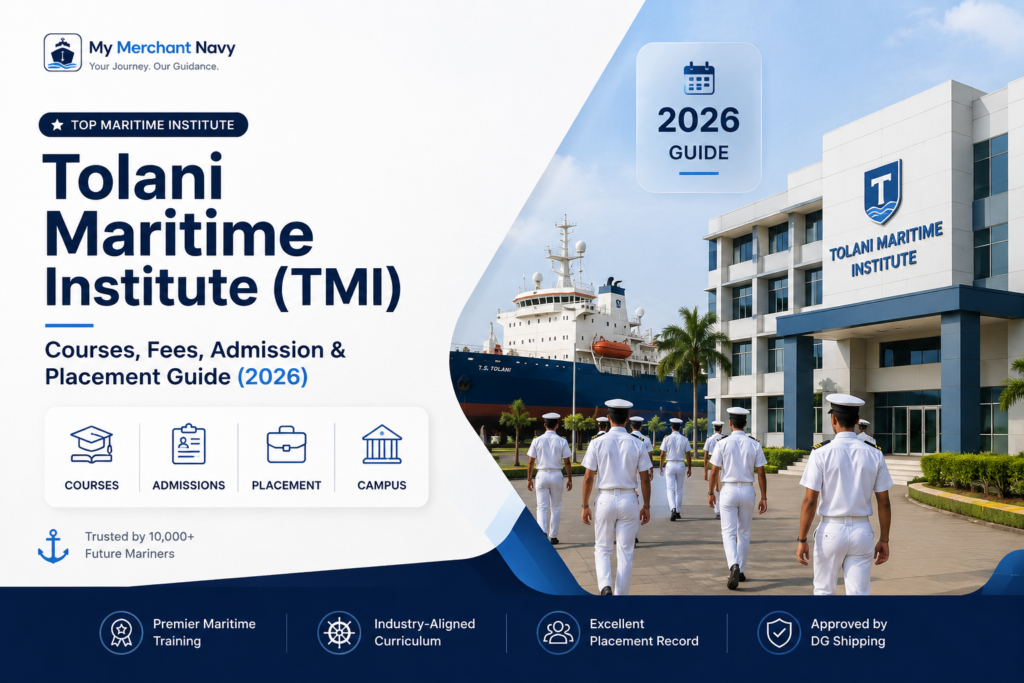
Tolani Maritime Institute is a private maritime higher education institute established in 1998, based at Talegaon Dabhade near Pune, Maharashtra. It’s approved by the Directorate General of Shipping (DGS), affiliated with Indian Maritime University (IMU), and also recognised by the Maritime and Port Authority of Singapore — a detail that matters for graduates aiming at international shipping companies. TMI’s degree programs have consistently earned an A1 (Outstanding) grade from DNV-GL under DG Shipping’s Comprehensive Inspection Programme, and the institute holds ISO certification. Independent rating agency CRISIL has also graded TMI as a top-tier maritime institute for placement and infrastructure quality.
Course | Level | Duration |
BTech Marine Engineering | UG (flagship program) | 4 years |
BSc Nautical Science | UG | 3 years |
Diploma in Nautical Science (DNS) | Diploma | 1 year pre-sea + 18 months onboard |
ETO (Electro-Technical Officer) Certificate Course | Certificate | 4 months (short-term) |
Postgraduate Diploma programs | PG | 1 year |
Shipboard Structured Training Programmes | Distance/onboard | Varies |
BTech Marine Engineering is TMI’s flagship and most popular course, though BSc Nautical Science and the ETO course are also widely sought after — TMI is one of the few institutes offering a strong, well-established version of all three major pre-sea pathways on one campus.
Fee figures for TMI vary meaningfully across sources and by intake year, so the table below reflects the range most consistently reported — always confirm the exact current figure with TMI directly before applying:
Course | Approx. Total Fees |
BTech Marine Engineering (4 years) | ₹9–27 lakh (varies significantly by year/source; recent figures trend toward the higher end) |
BSc Nautical Science (3 years) | ₹19–22 lakh |
Diploma in Nautical Science (DNS) | ₹6.78 lakh |
ETO Certificate Course | ₹4.1–4.3 lakh (male); around ₹3.44 lakh (female) |
Hostel fees | Approx. ₹1.85 lakh (additional) |
Application fee | ₹1,200 |
TMI’s fees sit meaningfully above government IMU campuses like T.S. Chanakya, which is the core trade-off prospective students weigh — a higher upfront cost against TMI’s placement track record and infrastructure reputation.
TMI admission runs through two entrance exams, which is a key difference from most other IMU-affiliated colleges:
Eligibility:
Entrance exams accepted:
Admission steps:
Placement is TMI’s strongest selling point relative to many alternatives:
As with any institute, treat specific placement percentages as indicative of a strong general track record rather than a guarantee for any individual candidate — actual outcomes depend on academic performance, interview rounds, and the hiring needs of partner shipping companies in a given year.
TMI offers merit-cum-need-based scholarships for UG maritime programs, particularly BTech Marine Engineering and BSc Nautical Science. Scholarship awards are based on a combination of academic performance, financial need, and gender-based support initiatives — worth checking current eligibility directly with the admissions office, since criteria and amounts are revised periodically.
TMI’s Talegaon Dabhade campus includes separate on-campus hostel accommodation for male and female students, along with the simulator labs, workshops, and sports/fitness infrastructure typical of a residential maritime training institute. The campus is often cited among the better-equipped private maritime institutes in India, which is part of what supports its premium fee positioning relative to government alternatives.
This is the comparison most aspirants actually want answered:
Neither is a wrong choice; the decision generally comes down to budget versus your priority on guaranteed-feeling placement outcomes.
One detail that sets TMI apart from most Indian maritime institutes is its recognition by the Maritime and Port Authority of Singapore (MPA). Singapore is one of the world’s busiest shipping registries and a major hub for global shipping company headquarters, so this recognition can carry practical weight for graduates targeting international employers based there or operating under Singapore flag vessels — it’s a credential worth highlighting on applications to companies with a Singapore presence, alongside TMI’s core DG Shipping and IMU approvals.
TMI has been operating since 1998, giving it close to three decades of alumni now working across ranks in the merchant navy — from sailing officers to shore-based technical and management roles. This depth of alumni network is part of what sustains TMI’s placement pipeline: many partner shipping companies have hired TMI graduates across multiple years, which reinforces the institute’s recruiter relationships and internship-to-placement conversion described above. For prospective students, this history is worth weighing alongside pure fee comparisons — an institute’s track record with a specific shipping company can matter more for individual outcomes than the headline placement percentage alone.
Yes, alongside IMU CET — TMI uses both exams as part of its selection process, which is different from IMU’s own campuses that rely on IMU CET alone.
Reported figures vary by source and year, generally falling in the ₹9–27 lakh range for the full 4-year course — always confirm the current figure directly with TMI before applying.
TMI is a private institute, though it is DG Shipping-approved and IMU-affiliated, and its degrees carry the same regulatory recognition as government campuses.
Yes, TMI offers a 4-month DG Shipping-approved ETO certificate course for BE/BTech electrical/electronics graduates, in addition to its flagship BTech and BSc programs.