
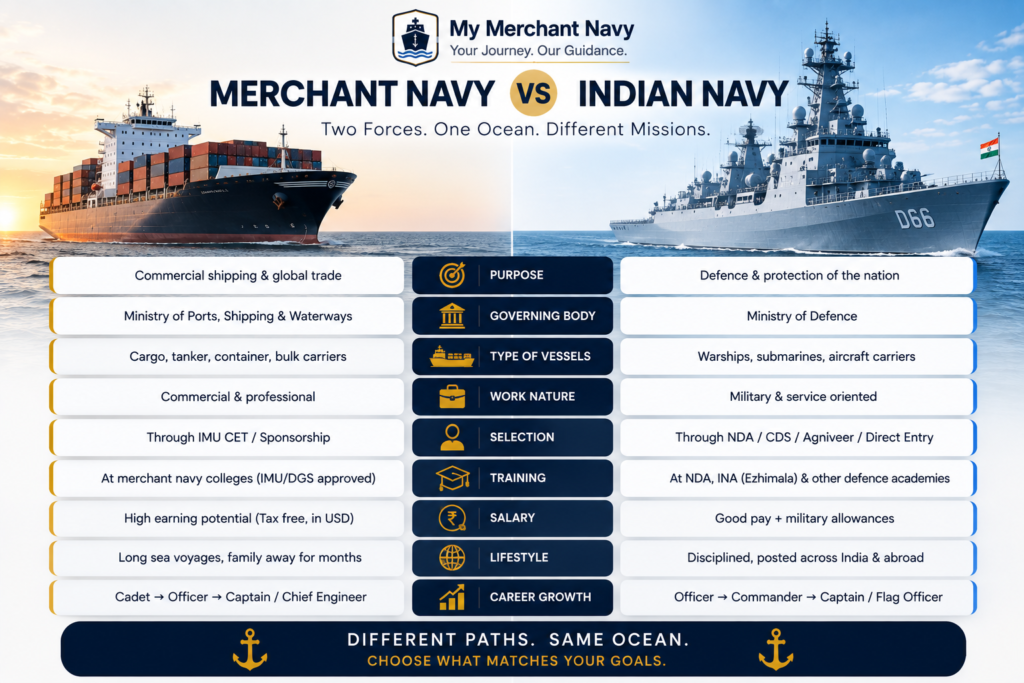
Both involve ships. Both involve the sea. Both wear uniforms that look confusingly similar to anyone outside the industry. But Merchant Navy vs. Indian Navy as career choices are about as different as a private airline and the Air Force — same sky, completely different jobs. This guide breaks down purpose, entry process, salary, lifestyle, and career growth so you can figure out which actually fits you.
The Merchant Navy is a civilian commercial profession. Merchant ships carry cargo — containers, crude oil, LNG, vehicles, grain, chemicals — between ports worldwide, plus passenger cruise routes. It’s essentially the logistics backbone of international trade, operating under private and international shipping companies, regulated in India by the Directorate General of Shipping (DGS).
The Indian Navy is a branch of the Indian Armed Forces. Its purpose is to protect India’s maritime borders, conduct naval operations, and contribute to national defence and international peacekeeping. It’s a government/military career, not a commercial one — officers are commissioned defence personnel, not employees of a private company.
This single distinction — commercial trade vs. national defence — drives every other difference between the two paths.
Factor | Merchant Navy | Indian Navy |
Entry route | IMU CET, company sponsorship exams, or private institute admission | NDA, CDS, TES, or Agniveer recruitment schemes |
Eligibility | 10+2 with PCM (varies by course), or GP Rating with just 10th pass | 10+2 (NDA) or graduation (CDS/TES), specific physical and medical standards |
Selection process | Written exam, interview, medical fitness | Written exam (SSB interview for officer entry), rigorous physical and psychological testing |
Training body | DG Shipping-approved maritime institutes (IMU, private academies) | Indian Naval Academy, National Defence Academy |
Commitment | Sponsorship bonds (2–3 years), otherwise flexible between companies | Fixed service commitment as commissioned defence personnel |
The Merchant Navy route is generally faster and more accessible — a 10th-pass student can enter through GP Rating in 6 months, while Indian Navy officer entry through NDA or CDS involves a longer, more selective, and physically demanding process, including the Services Selection Board (SSB) interview.
This is where the two paths diverge most dramatically, and it’s worth being precise rather than vague:
Rank/Stage | Merchant Navy | Indian Navy |
Entry-level (Cadet vs. fresh Lieutenant) | ₹25,000–85,000/month | ₹56,100–1,77,500/month (7th Pay Commission scale, plus allowances) |
Mid-career (10 years’ experience) | ₹5–8 lakh/month | ₹1.5–2 lakh/month |
Senior rank (Captain vs. Navy Captain) | ₹8–20 lakh/month | ₹2–2.5 lakh/month |
Pure salary-wise, Merchant Navy officers significantly outearn their Indian Navy counterparts at every comparable seniority level — a 10-year Merchant Captain can earn roughly ₹8–12 lakh/month against a Navy Captain’s ₹2–2.5 lakh/month. Over a full career, this gap compounds substantially, with some estimates putting a senior Merchant Navy officer’s lifetime earnings well ahead of a Navy counterpart’s.
But salary alone doesn’t tell the whole story. The Indian Navy offers a pension (commonly cited around ₹1–1.5 lakh/month post-retirement), lifelong medical coverage, housing benefits, and far greater job security — none of which the Merchant Navy provides, since it’s a private-sector career subject to company performance, economic cycles, and individual health/fitness requirements to keep sailing.
Merchant Navy income can be tax-free for seafarers who qualify as Non-Resident Indians (NRI) under Section 5 of the Income Tax Act — generally requiring 183+ days spent outside India in a financial year, which most active seafarers meet during standard 4–9 month contracts. Indian Navy salary, by contrast, is taxed as regular government salary income, though it comes with various allowances and, eventually, a pension that isn’t available in the Merchant Navy structure at all.
Factor | Merchant Navy | Indian Navy |
Nature of risk | Isolation, piracy in specific regions, extreme weather, physical hazards | Combat exposure, strict military discipline, frequent postings/relocations |
Work structure | Contract-based (3–9 months at sea, 2–4 months paid leave) | Continuous service with periodic postings and leave per military schedule |
Discipline level | Structured but civilian workplace hierarchy | Strict military discipline and command structure |
Family stability | Extended absences during contracts, but predictable leave blocks between them | Frequent relocations across postings, less predictable than contract cycles |
Job security | Tied to company performance and continued medical fitness to sail | High — a defined career track within the armed forces |
Neither risk profile is objectively “safer” — they’re just different categories of risk. Merchant Navy risk is largely environmental and occupational (weather, isolation, physical hazards); Indian Navy risk includes the possibility of combat deployment and carries the discipline demands of military service.
Both paths offer structured promotion ladders, but they function differently:
Neither is objectively “better” — they suit fundamentally different priorities and risk tolerances. A financially ambitious, adventure-seeking 18-year-old comfortable with less structural security may lean Merchant Navy; someone prioritising long-term stability, service to the nation, and guaranteed post-retirement benefits may find the Indian Navy the stronger fit.
Merchant Navy officers generally earn significantly more at every comparable rank — a senior Merchant Navy Captain can earn 4–5 times what a Navy Captain earns monthly — though the Indian Navy offers pension, lifelong medical coverage, and greater job security that the Merchant Navy doesn’t provide.
.
Generally yes — Merchant Navy entry (via IMU CET or sponsorship exams) is typically less selective and faster than Indian Navy officer entry through NDA or CDS, which involves the rigorous SSB interview process and stricter physical/medical standards.
No — the Merchant Navy is a private-sector career without a government pension system; retirement planning falls entirely on the individual, unlike the Indian Navy’s structured post-retirement pension and benefits.
Yes, for seafarers who qualify as NRI under the Income Tax Act by spending 183+ days outside India in a financial year — which most active seafarers meet through standard contract lengths.