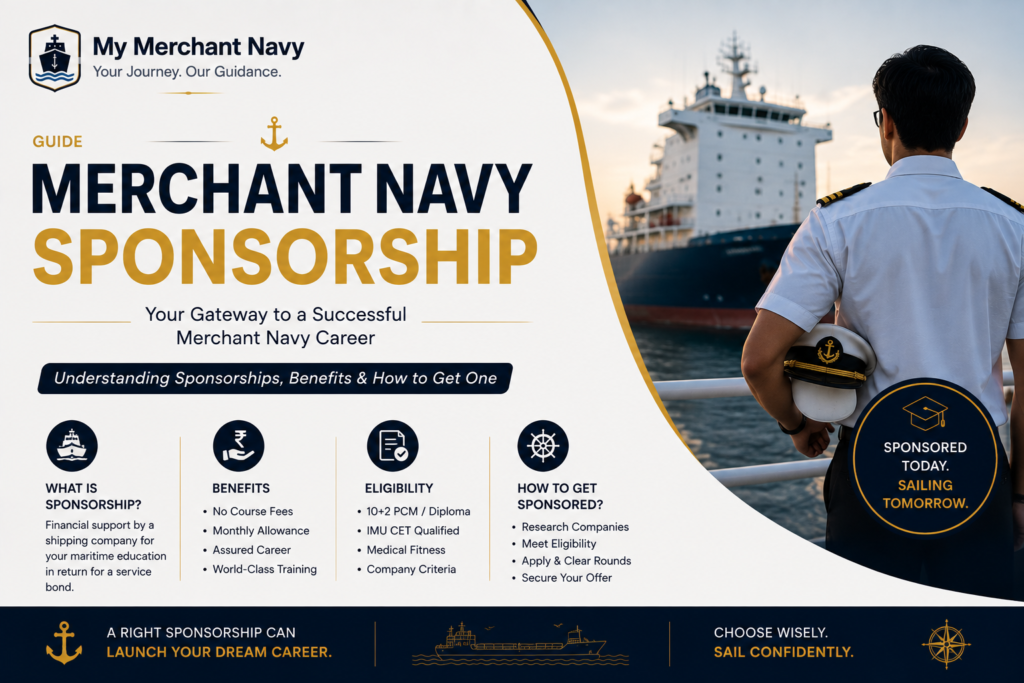
A common misconception worth clearing up first: merchant navy sponsorship is not a scholarship. It doesn’t typically cover your tuition fees the way a scholarship would. What it guarantees instead is your onboard training and job placement after completing your pre-sea course — the company arranges your sea training in advance, and in many cases the training cost is bundled into your course fee structure rather than waived separately. The real value isn’t free education; it’s the elimination of the post-training job search that non-sponsored candidates face.
Without a sponsoring company, you have no guaranteed way to accumulate sea time — no company means no signed Training Record Book, and no signed TRB means you can’t sit for your first Certificate of Competency exam. Non-sponsored cadets must independently approach shipping companies after completing training, which can mean months of delay hunting for placement while sponsored peers are already sailing and accumulating the sea time that drives every subsequent promotion.
Most sponsoring companies apply broadly similar baseline criteria, though exact thresholds vary company to company:
If you’re short by a small margin — say 5% in PCM aggregate — an improvement exam focused on your weaker subjects (commonly Mathematics or Chemistry) is often the fastest path to meeting a specific company’s threshold.
Nearly every company follows a broadly similar four-stage process, though the order and exact format vary slightly:
Final selection typically depends on cumulative performance across all four stages, not any single one in isolation.
Since most sponsorship exams closely mirror the IMU CET structure, the topic coverage overlaps heavily:
Because the syllabus overlap with IMU CET is so high, most of your IMU CET preparation directly transfers to sponsorship exam prep — there’s no need for a separate study track for the written component.
The interview stage is where many technically-qualified candidates actually lose their spot, since it tests things a written score can’t capture — composure, genuine interest in a seafaring career, and basic maritime awareness. A few practical points worth preparing:
A realistic preparation window is 8–12 months before your target sponsorship exam cycle — enough time to strengthen IMU CET-aligned academics, build aptitude and reasoning speed, prepare for the interview specifically, and address any medical readiness issues (like correctable vision problems) well before the actual medical examination.
Most sponsorships come attached to a service bond — typically 2–3 years of committed sailing with the sponsoring company after certification. Breaking this bond early generally carries financial consequences, since companies structure sponsorship as an investment they expect to recoup through your service period; exact penalty terms (a fixed buyout amount, repayment of training costs, or a combination) vary by company and are specified in the sponsorship agreement you sign at the outset. It’s worth reading this agreement carefully before accepting a sponsorship offer — understanding the exit terms upfront, even if you have no intention of leaving early, is simply sound practice before committing several years of your career to a single company.
No — sponsorship guarantees onboard training and job placement after your course, but it typically doesn’t cover tuition fees the way a scholarship would.
Most companies set a baseline of 60% aggregate in PCM, though some — like Anglo-Eastern — require up to 70%. Always check the specific sponsoring company’s current threshold.
A realistic preparation window is 8–12 months, covering IMU CET-aligned academics, aptitude practice, interview readiness, and medical fitness.
Yes, and it’s generally advisable — building a shortlist of 3–4 companies rather than relying on a single application improves your overall chances of securing a sponsored seat.