
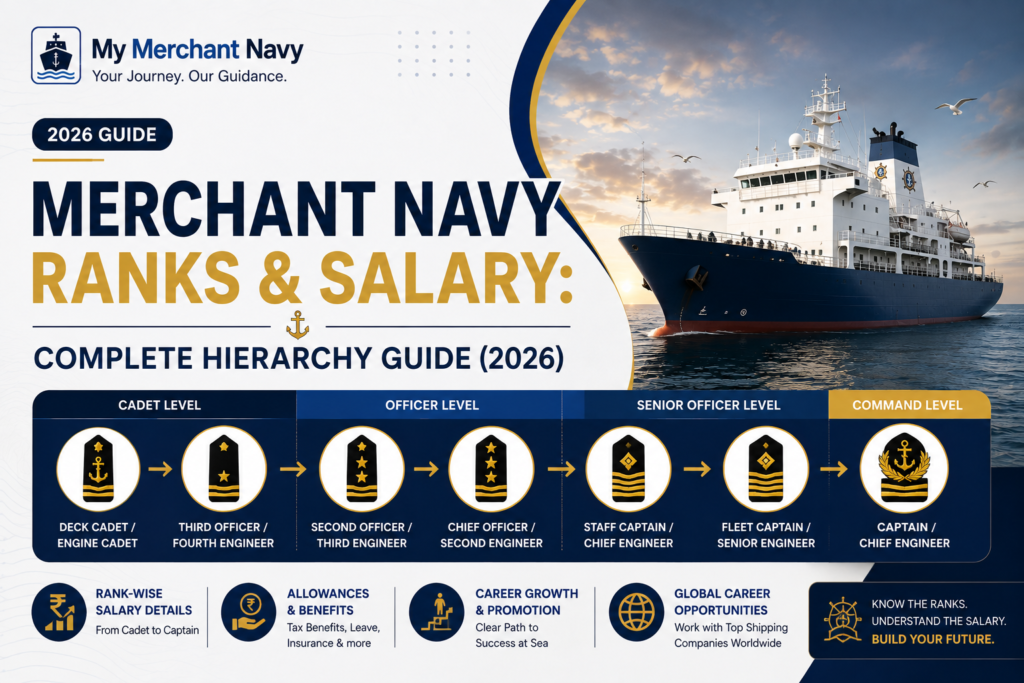
A merchant ship operates 24/7, often in the middle of the ocean, with no external help available in an emergency. The rank structure exists so that:
This is also why merchant navy salary is so closely tied to rank: pay reflects certified competency and legal responsibility, not just years on the job.
The Deck Department handles navigation, cargo operations, safety, and overall ship handling. It’s the department most students join after clearing IMU-CET or a similar entrance route.
|
Rank |
Role |
Monthly Salary (₹) |
|
Deck Cadet |
Trainee, learns navigation & cargo basics |
25,000 – 85,000 |
|
3rd Officer |
Handles safety equipment, watchkeeping |
1,00,000 – 1,50,000 |
|
2nd Officer |
Navigation officer, voyage planning |
1,50,000 – 3,00,000 |
|
Chief Officer |
Second-in-command, runs cargo & deck ops |
3,00,000 – 6,00,000 |
|
Captain / Master |
Overall command and legal responsibility |
6,00,000 – 20,00,000+ |
Deck ratings (non-officer roles supporting this department) include Bosun, Able Seaman (AB), and Ordinary Seaman (OS), typically earning between ₹25,000 and ₹1 lakh per month depending on experience.
The Engine Department keeps the ship’s propulsion, power generation, and machinery running. This route suits students with a marine engineering background.
|
Rank |
Role |
Monthly Salary (₹) |
|
Engine Cadet |
Trainee, learns machinery operations |
25,000 – 85,000 |
|
4th Engineer |
Junior watchkeeping engineer |
1,00,000 – 1,50,000 |
|
3rd Engineer |
Handles auxiliary machinery |
1,20,000 – 2,00,000 |
|
2nd Engineer |
Runs engine room operations day-to-day |
1,50,000 – 3,00,000 |
|
Chief Engineer |
Head of engine department, second only to Captain in authority |
6,00,000 – 20,00,000+ |
Engine ratings include Motorman, Fitter, Oiler, and Wiper — support roles earning roughly ₹25,000 to ₹1.5 lakh per month depending on rank and experience.
Alongside these two core departments, most modern ships also carry an Electro-Technical Officer (ETO), responsible for electrical and automation systems, earning between ₹1 lakh and ₹4 lakh per month — a specialised, well-paid role that’s grown fast as ships have become more automated.
Smaller in size but essential for crew welfare, the Catering Department covers food and accommodation for everyone on board.
|
Rank |
Role |
Monthly Salary (₹) |
|
Trainee Cook / Steward |
Entry-level support |
30,000 – 50,000 |
|
Chief Cook |
Manages galley operations |
50,000 – 1,00,000 |
|
Chief Steward |
Oversees crew accommodation & catering |
60,000 – 1,20,000 |
The biggest misconception about merchant navy salary is that it grows with time served. In reality, it grows with rank, and rank only changes when you clear the next certificate of competency exam plus meet your required sea time. This means:
This timeline can compress for officers who clear exams on the first attempt and sail with companies that offer faster sign-on cycles, or stretch out for those who take gaps between contracts.
Since salary at equivalent ranks is broadly similar between Deck and Engine, the choice usually comes down to aptitude rather than pay:
Neither path is a “better” earner overall — Captains and Chief Engineers both sit at the top of the pay scale, and both require roughly the same number of years and exams to reach.
Merchant navy ranks and salary are really one system, not two — your pay at any point is a direct reflection of your rank, your certifications, and the ship type you’re sailing on. If you’re just starting out, the fastest way to grow your income isn’t to switch companies constantly — it’s to clear your CoC exams on schedule and accumulate the right sea time for your next rank.
The Captain (Master) is the highest rank on a ship, holding overall command and legal responsibility for the vessel, crew, and cargo. On the engine side, the equivalent top rank is Chief Engineer.
The jump from Cadet to 3rd Officer/4th Engineer and again from 2nd Officer/2nd Engineer to Chief Officer/1st Engineer are typically the two biggest salary jumps in a seafarer’s career, since both require clearing a new certificate of competency.
Yes, broadly — equivalent ranks (e.g., 2nd Officer and 2nd Engineer) earn similar salary ranges. The bigger salary differences come from ship type and company, not from choosing Deck over Engine or vice versa.
Most officers reach Captain rank in 12-15 years, assuming they clear each certificate of competency exam on schedule and complete the required sea time at every rank without major gaps between contracts.