
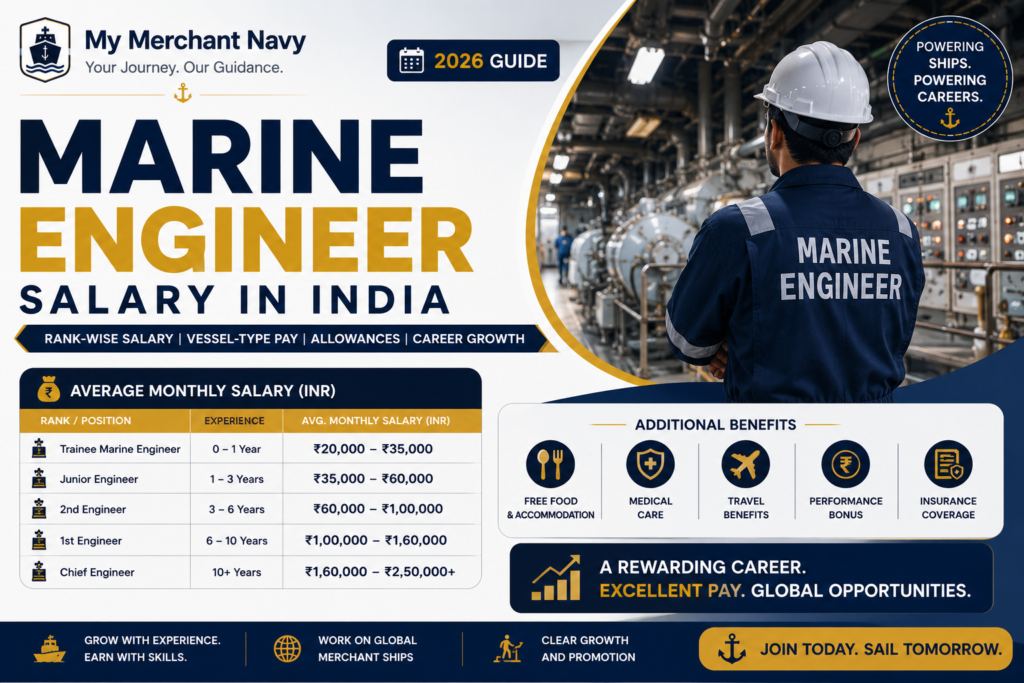
Marine Engineer is one of the most searched job titles in Indian career research — and one of the most confusingly reported, since generic salary aggregators mix shore-based engineering roles with actual sailing merchant navy officers. This guide sorts through that confusion and gives you the real, rank-wise progression for a marine engineer sailing on merchant ships, from Engine Cadet to Chief Engineer.
If you search generic salary sites, you’ll find wildly inconsistent numbers — some report an average “Marine Engineer” salary of roughly ₹30,000/month, others report ₹10–18 lakh/year, and some report averages north of ₹18 lakh annually. This isn’t inconsistent reporting of the same job — it’s different job pools being blended together. Sites like Indeed, Glassdoor, and PayScale often pull from a mix of shore-based mechanical/marine engineering roles (shipyard engineers, naval architects, marine consultancy staff) alongside actual sailing merchant navy engineers, and these are genuinely different careers with different pay structures. The figures in this guide are specifically for sailing marine engineers on merchant ships — the BTech Marine Engineering / GME career path that leads through the engine department rank ladder.
Rank | Approx. Monthly Salary (INR) | Approx. USD Equivalent | Typical Years to Reach |
Engine Cadet (training) | ₹25,000–85,000 | — | Year 1 |
Fourth Engineer | ₹1.5–3.5 lakh | $1,500–2,500 | Year 2–4 |
Third Engineer | ₹2.5–5 lakh | $2,500–4,000 | Year 4–7 |
Second Engineer | ₹5–8 lakh | $4,500–7,000 | Year 7–12 |
Chief Engineer | ₹6.6–15 lakh (up to ₹20 lakh on premium vessels) | $8,000–14,000 (up to $20,000 on LNG) | Year 12–15+ |
These ranges are compiled from multiple current industry sources and, as with most merchant navy pay data, vary by vessel type, company, and whether the vessel is Indian-flagged or foreign-going — treat them as realistic bands rather than fixed numbers.
Three factors move the number more than anything else:
The engine and deck departments run largely parallel pay ladders at each seniority level:
Engine Department | Deck Department (Equivalent Rank) |
Engine Cadet | Deck Cadet |
Fourth Engineer | Third Officer |
Third Engineer | Second Officer |
Second Engineer | Chief Officer |
Chief Engineer | Captain / Master |
Pay at equivalent ranks is broadly comparable, with Chief Engineer sometimes matching or exceeding Captain’s pay specifically on gas carriers, where steam or dual-fuel engineering expertise commands a premium that general command experience doesn’t match.
Marine engineers aren’t limited to sailing indefinitely. After 15+ years, many move into shore-based technical roles:
Shore-based roles after a sailing career are commonly reported in the ₹2–5 lakh/month range — often a step down from peak sailing Chief Engineer pay, but with the trade-off of a stable, land-based lifestyle after years of sea postings.
Both routes lead into the same Engine Cadet → Fourth Engineer → Chief Engineer ladder described above; GME simply gets an already-qualified mechanical engineer to sea faster.
Marine engineer income is tax-exempt in India for those qualifying as Non-Resident Indians (NRI) under seafarer tax rules — generally requiring 183+ days spent outside India in a financial year due to sea service. This is a significant practical advantage at officer-level pay, particularly from Third Engineer upward.
Unlike most shore-based careers, a sailing marine engineer’s pay isn’t tied to an Indian city at all — salary is set by the employing shipping company and paid regardless of where the officer’s family is based on land. Where “city” does matter is indirectly: candidates from Mumbai, Chennai, and Kolkata tend to have easier access to major shipping company offices and placement interviews simply due to those cities hosting India’s largest maritime employers and training institutes, which can translate into faster placement after training rather than a different pay scale. If you’re researching this while based outside a major port city, it’s worth knowing that your eventual salary won’t be discounted for it — only your access to interviews and sponsorship opportunities might require more active outreach.
Engine Cadets typically earn ₹25,000–85,000 per month during training, rising to ₹1.5–3.5 lakh once promoted to Fourth Engineer after clearing initial CoC requirements.
Generic aggregators often blend shore-based mechanical/marine engineering job titles with actual sailing merchant navy officers, producing inconsistent averages. Figures specific to sailing officers, as shown in this guide, are more reliable for merchant navy career planning.
Chief Engineers on premium vessel types like LNG carriers with top-tier international companies are reported earning up to $20,000/month (roughly ₹16.8–18.8 lakh), among the highest sustained earning potential in the merchant navy.
Yes, for those qualifying as NRI seafarers under applicable tax rules — generally requiring 183+ days spent outside India in a financial year due to sea service.