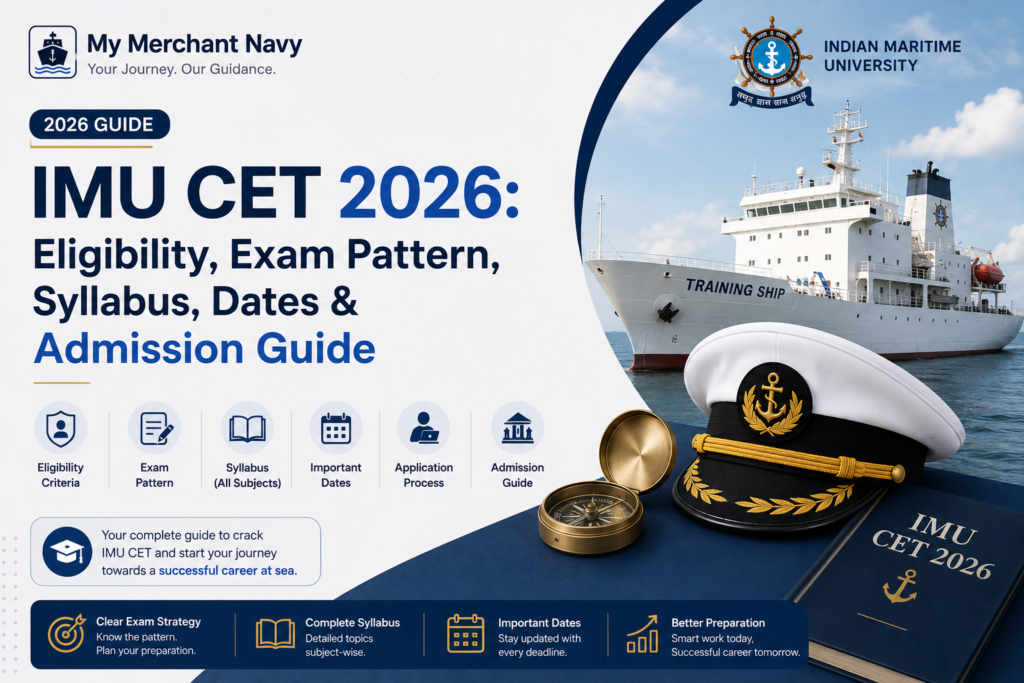
IMU CET is a national-level, computer-based entrance test conducted annually by Indian Maritime University to admit students into its undergraduate, postgraduate, and diploma maritime programs. It’s the primary — and for most programs, the only — route into IMU’s six directly-run campuses (Chennai, Navi Mumbai, Mumbai Port, Kolkata, Kochi, Visakhapatnam) as well as most DG Shipping-approved affiliated institutes across India, including several private colleges covered elsewhere on this site.
Courses admitted through IMU CET include BSc Nautical Science, BTech Marine Engineering, BTech Naval Architecture & Ocean Engineering, Diploma in Nautical Science (DNS), BBA in Shipping/Logistics, MBA in Port and Shipping Management, and MTech programs — each with its own eligibility and paper structure.
For UG technical programs (BTech, BSc Nautical Science, DNS):
For MBA programs (Port and Shipping Management / International Transportation and Logistics Management):
For MTech programs:
Particular | Detail |
Mode | Computer-Based Test (CBT) |
Duration | 3 hours |
Number of questions (UG technical) | 200 multiple-choice questions (some cycles report 150 — confirm the current year’s exact count in the official notification) |
Sections (UG technical) | Physics, Chemistry, Mathematics, English, General Aptitude |
Number of questions (MBA/MTech) | 120 questions each |
Negative marking | 0.25 marks deducted per wrong answer, across all papers |
Simultaneous papers | UG, MBA, and MTech papers are held on the same date and time — a candidate can attempt only one |
The syllabus for UG technical programs largely follows the Class 11 and 12 CBSE curriculum, split across five sections:
For MBA and MTech papers, the syllabus shifts toward quantitative aptitude, verbal ability, logical reasoning, and (for MTech) core engineering fundamentals relevant to the specific specialisation.
Based on the most recently concluded cycle, here’s how the annual calendar typically unfolds — use this as a reference for planning, but always confirm exact dates from the official notification each year:
Event | 2026 Cycle Date |
Application form release | Early February 2026 |
Registration deadline | Late April 2026 |
Online city/exam-centre selection window | Early May 2026 |
Admit card release | Mid-May 2026 |
Exam date | Late May 2026 |
Result declaration | Mid-June 2026 (typically within 10 days of the exam) |
IMU CET is conducted annually, and the schedule generally follows a similar academic-calendar pattern year to year — bookmark imu.edu.in directly for the next cycle’s confirmed dates rather than relying on last year’s schedule.
This fee applies to both UG and PG program applications.
Cutoff ranks vary significantly by campus, course, category, and year — T.S. Chanakya (IMU Navi Mumbai) and IMU Chennai typically see tighter competition and higher cutoffs than IMU Visakhapatnam or Kolkata, given their stronger brand recognition. There’s no single fixed cutoff number worth quoting here, since it moves every cycle based on that year’s applicant pool and seat availability — check the previous year’s official cutoff data on imu.edu.in for the most reliable reference point specific to your target campus and course.
IMU reserves a portion of seats for candidates from the Andaman and Nicobar Islands, Lakshadweep and Minicoy Islands, the eight North-Eastern states, and Jammu and Kashmir, in addition to standard category reservations — a structure not typically found at private maritime institutes.
Yes — admission to all six IMU campuses and most affiliated institutes runs entirely through IMU CET and the subsequent counselling process.
It’s required for all six IMU campuses and most affiliated institutes, though a few specialised programs — like the Shipping Corporation of India’s Maritime Training Institute — use their own direct selection process instead.
Generally yes, often by a significant margin — government BTech Marine Engineering fees commonly run ₹75,000–11 lakh depending on campus, compared to ₹9–27 lakh at many private institutes for the same degree.
₹1,200 for General/EWS/OBC (NCL) candidates and ₹800 for SC/ST candidates, applicable to both UG and PG program applications.