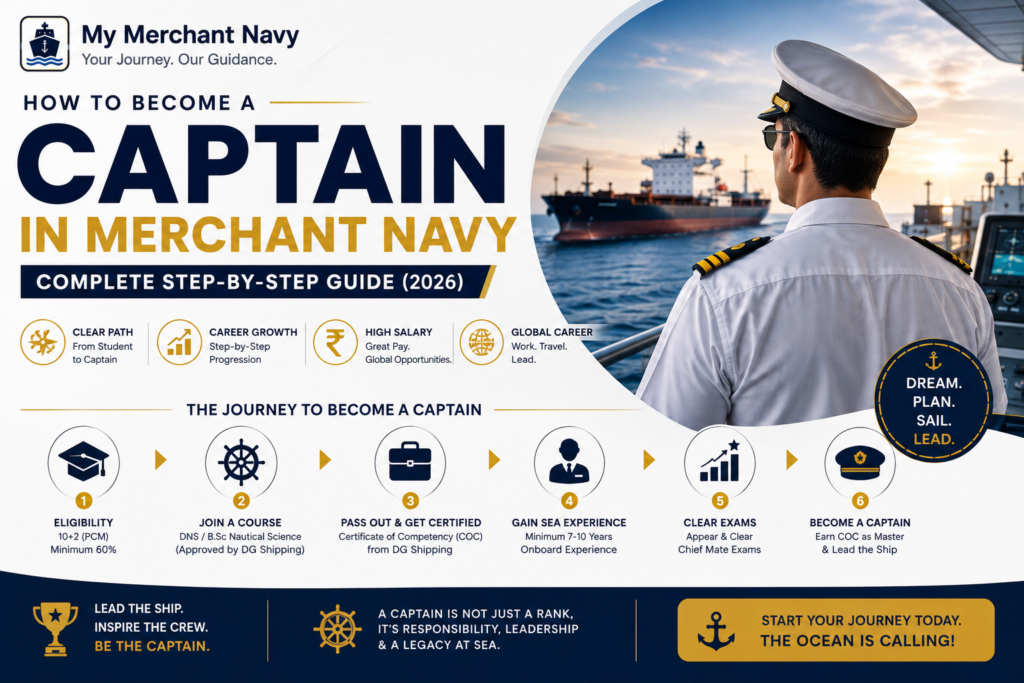
Becoming a Captain (Master Mariner) is the top of the deck department career ladder — full command of a merchant vessel, its cargo, crew, and legal compliance with international maritime law. It’s also a long road: realistically 12–18 years from your first day of training to your first command. This guide walks through every step, exam, and sea-time requirement along the way, honestly, without the compressed timelines some coaching institutes promise.
Admission to a deck-officer training program runs primarily through IMU CET (Indian Maritime University Common Entrance Test), the national-level exam required for Indian Maritime University’s own campuses and most affiliated institutes. Some private institutes also run their own entrance tests (like TMISAT at Tolani Maritime Institute) or accept company-sponsored selection processes instead.
Two main pathways lead into the deck department:
Both lead to eligibility for the same Certificate of Competency (CoC) exam ladder — DNS gets you to sea faster, while BSc offers deeper academics and is often preferred by top-tier shipping companies.
This is the step most first-time applicants underestimate. Without a shipping company willing to sign your Training Record Book (TRB), you cannot accumulate the sea time required to sit for your first CoC exam — the Directorate General of Shipping (or Mercantile Marine Department) will not admit you to the exam without a properly signed TRB. Sponsorship is typically secured either before joining your pre-sea training institute or during/after the first year, through a written test, interview, and psychometric assessment conducted by the shipping company. Some companies pay a stipend during sea training (₹10,000–30,000/month); others cover training fees in exchange for a 2–3 year service bond after certification.
Once training and sponsorship are in place, you join a ship as a Deck Cadet — typically 18 months of onboard training, learning navigation, bridge watchkeeping, cargo operations, and safety procedures under supervision. This sea time is mandatory before you’re eligible to sit for your first officer-level competency exam.
After completing cadetship sea time and required courses, you appear for the Second Mate examination — written, oral, and signalling components, conducted by DG Shipping examiners. Passing this earns your Second Mate Certificate of Competency, which qualifies you to sail as Third Officer, and later Second Officer with further sea time.
At least 12 months of sea service as Third or Second Officer is required before the next exam stage. During this period, you take on greater responsibility for navigation charts, firefighting appliances, and life-saving equipment — building the operational judgment the next certification level assumes you already have.
After completing required sea time and mandatory STCW courses (including RANSCO and Chief Mate Phase I & II), you sit for the Chief Mate examination. Passing earns your Chief Mate CoC, qualifying you to sail as Chief Officer — a senior role managing cargo operations, safety drills, and overall deck department leadership, reporting directly to the Captain.
Roughly 12 months of sea service as Chief Officer is required before you become eligible for the final exam stage. This is where leadership experience genuinely gets tested — you’re effectively running the deck department day to day.
The final step is the Master’s examination — written and simulator-based components, covering advanced ship handling, navigation, maritime law, and crisis management. Passing earns your Master (FG) Certificate of Competency, which qualifies you for your first command as Captain (Master Mariner) of a merchant vessel.
Coaching institutes sometimes advertise compressed timelines, but a grounded, honest estimate — based on consistent sea-time requirements at each CoC stage and typical exam-preparation gaps — is 12–18 years from starting pre-sea training to first command, assuming consistent sea service without major gaps. This breaks down roughly as:
Stage | Approx. Timeline |
Pre-sea training + cadetship | Years 0–2 |
Third/Second Officer (post-Second Mate CoC) | Years 2–4 |
Chief Officer (post-Chief Mate CoC) | Years 4–8 |
Captain (post-Master’s CoC) | Years 8–15+ |
Actual timing varies by how quickly sea-time requirements are fulfilled, exam-clearing speed, and company-specific promotion practices.
Passing exams alone doesn’t make someone a strong Captain candidate. Companies and examiners also look for:
A few recurring gaps are worth planning around rather than being surprised by later. Sponsorship delays are the most common — some cadets complete pre-sea training without a confirmed sponsoring company lined up, which stalls sea time entirely until one is secured. Exam-attempt gaps also add time, since CoC exams have a genuine failure rate and re-attempts require waiting periods plus refresher preparation. Medical disqualification during periodic fitness checks (not just the initial one) can also interrupt sea service unexpectedly. None of these are reasons to avoid the path, but factoring a buffer into your own timeline expectations — rather than assuming the fastest-case scenario some marketing materials describe — leads to a far more realistic career plan.
A realistic timeline is 12–18 years from starting pre-sea training to first command, assuming consistent sea service without major gaps — shorter timelines advertised by some institutes are generally not representative of typical career progression.
It’s the primary entrance route for IMU campuses and most affiliated institutes, though some private academies run their own entrance tests or company-sponsored selection processes instead.
Yes, effectively — without a shipping company signing your Training Record Book, you cannot accumulate the sea time required to sit for CoC exams at any stage of the ladder.
Both lead to the same CoC exam ladder and ultimately the same Captain rank — DNS is faster and cheaper, while BSc Nautical Science offers deeper academics and is often preferred by top-tier shipping companies for cadet sponsorship.