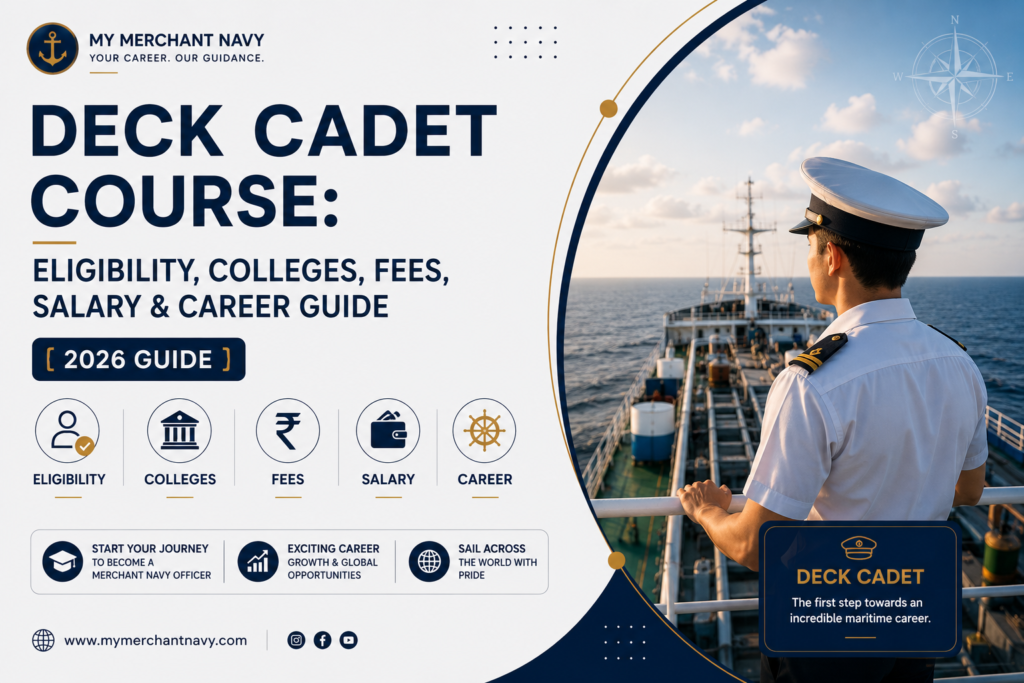
A Deck Cadet is a trainee navigating officer on a merchant ship, responsible for learning navigation, watchkeeping, cargo operations, and bridge procedures under the supervision of senior deck officers. It’s the entry point into the deck department of the merchant navy — the path that eventually leads to Second Officer, Chief Officer, and ultimately Captain (Master Mariner). Deck Cadet training in India is offered through two recognised routes:
Both are DG Shipping-approved and lead to eligibility for the Second Mate Certificate of Competency (CoC) exam, but they differ meaningfully in duration, cost, and long-term recognition.
Admission for both BSc Nautical Science and DNS typically proceeds through three stages: entrance exam/counselling, interview, and a DG Shipping-approved medical test.
Factor | BSc Nautical Science | DNS |
Duration | 3 years (classroom + sea training) | 1 year pre-sea + 18 months onboard |
Outcome | Full degree, more theory depth | Diploma; can later convert to BSc (Applied Nautical Science) via distance learning during sea time |
Cost | Higher overall | Lower — shorter pre-sea component |
Company preference | Top-tier shipping companies generally prefer BSc cadets | Fewer companies offer sponsorship, mainly Synergy, Scorpio, Anglo-Eastern, Torm |
Best for | Students who want deeper academics, campus life, and stronger long-term company options | Students who want to start earning at sea sooner and minimise upfront cost |
Fees vary sharply between government-subsidised IMU campuses and premium private institutes.
Institute | Location | Approx. Total Fees (3-yr BSc) | Notes |
IMU Navi Mumbai (T.S. Chanakya) | Navi Mumbai | ₹6.6–8.25 lakh (male) / lower for female cadets | India’s most established deck-cadet institute; recruiters include Anglo-Eastern, Fleet Management, BSM, PIL, TORM, NYK |
IMU Kolkata / Chennai / Kochi / Visakhapatnam | Multiple cities | ₹4.2–6.6 lakh (varies by campus, gender-based fee difference) | Central university campuses; most affordable government route |
Tolani Maritime Institute (TMI), Pune | Pune | ₹18–20 lakh | Near-100% placement record with Maersk, MOL, MSI, Chevron |
Academy of Maritime Education and Training (AMET), Chennai | Chennai | ₹11.81 lakh | Strong sponsorship ties with Maersk Line, Synergy, V-Ships |
The Great Eastern Institute of Maritime Studies (GEIMS), Lonavala | Pune | ₹8–12 lakh (approx.) | Also offers ETO course on the same campus |
T.S. Rahaman Academy | Mumbai | Mid-range | One of the oldest maritime training institutes in India; sponsorship with Anglo-Eastern Group, Fleet Management |
Anglo-Eastern Maritime Academy (AEMA), Karjat | Mumbai | Mid-to-premium | Own fleet (Anglo Eastern Ship Management) offers direct placement pathway |
Fees vary by intake year, gender-based subsidy at government institutes, and whether a company sponsorship covers part of the cost. Always verify current figures directly with the institute.
DNS is meaningfully cheaper since the classroom component is only one year. Government/IMU-affiliated DNS programs generally cost less than the equivalent first year of a BSc program, though exact figures vary by institute and are best confirmed directly, as DNS fee structures are less standardised across the sector than BSc pricing.
Sponsorship materially changes the cost equation. At IMU campuses, sponsorship rates run high — some institutes report 90%+ of cadets receiving company sponsorship, typically starting after the first year, with the sponsoring company covering remaining fees in exchange for a 3–5 year service bond. Top sponsoring companies include Maersk, MSC, PIL, Anglo-Eastern, and Fleet Management.
Pay rises steeply and predictably with each rank on the deck side:
Rank | Approx. Monthly Salary |
Deck Cadet (training) | ₹25,000–₹80,000, depending on shipping company and vessel type |
Third Officer (after Second Mate CoC) | ₹1.2–₹3 lakh |
Chief Officer | ₹4–7 lakh |
Captain (Master Mariner) | ₹5–20 lakh, tax-free for qualifying sea-time |
A few practical notes on real earnings:
Deck officers aren’t limited to sailing careers. Experienced officers commonly move into:
BSc offers deeper academics and is generally preferred by top-tier shipping companies, but DNS gets you to sea faster and at lower upfront cost — the right choice depends on your budget and how quickly you want to start earning.
Deck Cadets typically earn ₹25,000–₹80,000 per month during training, depending on the sponsoring company and vessel type.
It’s the primary entrance route for IMU campuses and most affiliated colleges, though some private institutes and company-sponsored programs run their own selection process instead.
Yes — IMU and most private institutes admit female cadets, and government institutes often offer a reduced fee structure for female candidates.