
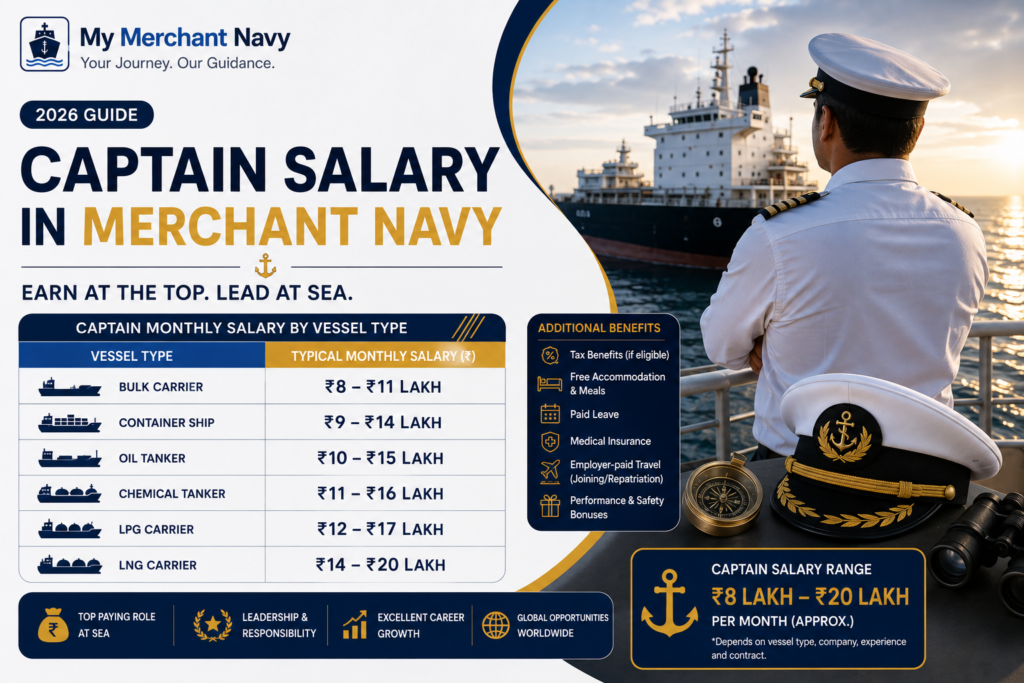
The Captain, or Master Mariner, holds the highest rank on any merchant ship — and the highest salary. If you’ve been researching merchant navy careers, you’ve probably already seen wildly different figures for captain salary in merchant navy: some sources quote ₹8 lakh a month, others quote ₹20 lakh, and a few even mention ₹30-40 lakh. All of these can be true at the same time, because captain salary depends heavily on the ship type, company, flag state, and years of command experience.
This guide breaks down exactly what a merchant navy captain earns, why the range is so wide, and what it actually takes to reach this rank.
Before looking at the number, it helps to understand why the role pays so much. The Captain (Master) holds overall legal and operational responsibility for:
Unlike most jobs, a Captain’s decisions carry direct legal liability — which is a major reason captain salary in merchant navy sits well above every other rank on the ship.
Based on current industry data, DGS-linked benchmarks, and ITF wage guidelines, here’s how captain salary typically breaks down:
Experience Level | Monthly Salary (₹) |
New Captain (first command) | 6,00,000 – 8,65,000 |
Experienced Captain (5-10 years in command) | 8,65,000 – 15,00,000 |
Senior Captain (10-20 years, international company) | 15,00,000 – 20,00,000+ |
Captain on specialized vessel (LNG/large tankers) | 20,00,000 – 40,00,000 |
A few sources quote even higher figures — up to ₹30-40 lakh per month, or ₹2-3 crore annually — for Captains with 20+ years of experience commanding large specialized vessels for top-tier international shipping companies. These figures sit at the very top of the scale and aren’t representative of a typical Captain’s pay, but they show the ceiling this rank can reach.
Five factors explain the wide range you’ll see across different sources:
LNG carriers, large crude oil tankers, and chemical tankers pay significantly more than container ships or bulk carriers, because commanding these vessels requires additional certification and carries higher operational risk. A Captain on an LNG carrier can easily earn 40-50% more than a Captain on a general cargo ship.
International shipping companies — especially those based in Europe, the Middle East, or East Asia — typically pay 20-40% more than Indian coastal shipping companies for the same rank, due to differences in flag-state wage structures and market competition for experienced Masters.
The country under which a ship is registered (its “flag”) determines the regulatory wage floor. Ships flagged in countries with higher living-cost benchmarks generally pay more, even for the same route and cargo.
Captains often negotiate re-joining bonuses or seniority pay when returning to the same company for multiple contracts, which can meaningfully raise effective monthly earnings beyond the base pay figure quoted in most salary charts.
Salary does not jump the moment someone is promoted to Captain — it continues to grow with every additional contract cycle, as companies reward proven safety records and reliability with higher pay on subsequent assignments.
Reaching Captain rank isn’t just about years served — it requires clearing a defined sequence of certificate of competency (CoC) exams alongside accumulating sea time at each rank:
Most officers reach Captain rank in 12-15 years, though this can compress for those who clear every exam on the first attempt and sail continuously without long gaps between contracts, or stretch out for those who take breaks or need multiple attempts at an exam.
Like other merchant navy ranks, a Captain’s income can be tax-free in India, but only under specific conditions:
Given that Captains often serve on international vessels with long contract cycles, many do qualify for this exemption — but it depends entirely on individual sailing patterns each financial year, not on the rank itself.
The quoted monthly salary is only part of a Captain’s total compensation. Additional components typically include:
When these are factored in alongside potential tax exemption, the effective value of a Captain’s compensation package is meaningfully higher than the base salary figure alone suggests.
Captains and Chief Engineers sit at the same level in the ship’s hierarchy and earn broadly similar salaries, since both hold ultimate responsibility for their respective departments — the Captain for overall command, the Chief Engineer for all machinery and propulsion systems. Neither role is a definitively “higher-paying” path; the choice between the Deck and Engine tracks usually comes down to aptitude rather than expected pay at the top.
Captain salary in merchant navy isn’t a single number — it’s the result of years of exams, sea time, ship-type specialization, and company choice compounding on top of each other. A realistic new Captain can expect to start around ₹6-8 lakh per month, with experienced Captains on international vessels comfortably crossing ₹15-20 lakh, and top-tier command on specialized vessels pushing well beyond that. If Captain is your target rank, the fastest route there is a consistent exam-and-sea-time record from Cadet onward, not job-hopping between companies.
For details on the exams, sea time requirements, and courses that lead to a command career, browse the other career guides on MyMerchantNavy.com.
A typical new Captain earns between ₹8 lakh and ₹12+ lakh per month, with experienced Captains on international vessels earning ₹15-20 lakh per month, and senior Captains on specialized vessels like LNG carriers earning even more.
LNG carriers, large crude oil tankers, and chemical tankers typically pay the highest captain salaries, often 40-50% more than general cargo or bulk carrier commands, due to the additional certification and risk involved.
Yes, broadly — equivalent ranks (e.g., 2nd Officer and 2nd Engineer) earn similar salary ranges. The bigger salary differences come from ship type and company, not from choosing Deck over Engine or vice versa.
It can be, but only if the Captain qualifies as an NRI by spending 183 days or more outside India in a financial year and earns the income on a foreign-flagged vessel. It is not automatically tax-free for every Captain.