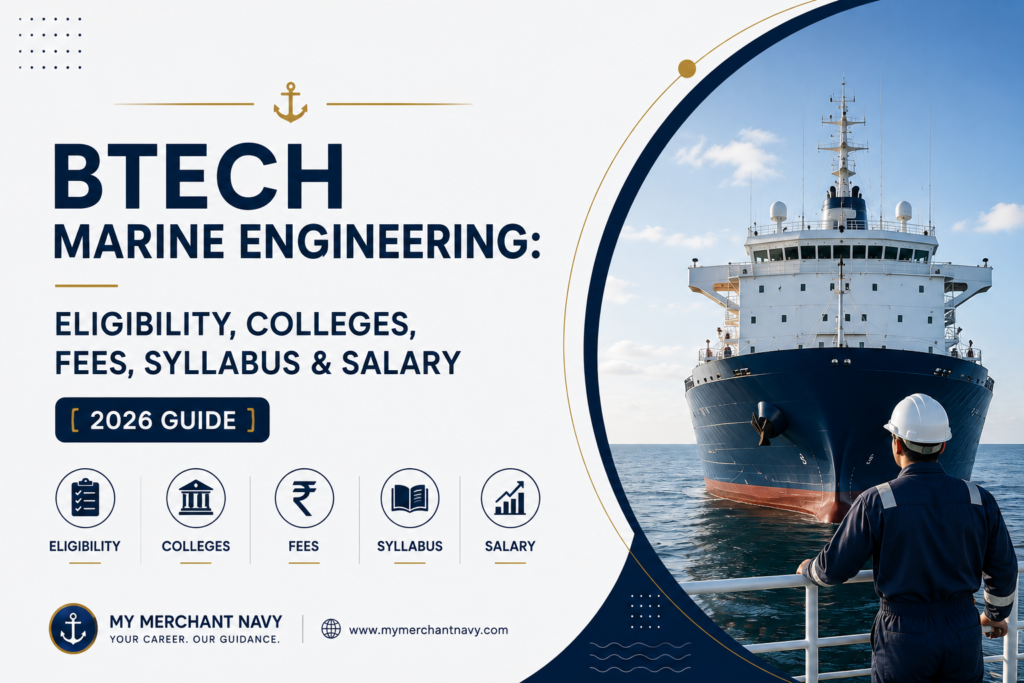
BTech Marine Engineering is a four-year undergraduate degree that trains students to design, operate, and maintain the propulsion, electrical, and mechanical systems on board ocean-going ships. It blends core mechanical engineering with naval architecture, marine propulsion, ship stability, and control systems. Graduates typically sail as Engine Cadets before working their way up through 4th, 3rd, 2nd, and eventually Chief Engineer ranks on merchant vessels — or move into shore-based roles in shipyards, port trusts, and technical superintendency.
The entry criteria are fairly consistent across most institutes:
Admission to most DG Shipping-approved and IMU-affiliated colleges is entrance-exam based:
<cite index=”12-1″>Fresher Engine Cadets typically earn ₹20,000–₹40,000 per month during sea training, and salary rises significantly with each promotion.</cite> Because starting pay is tied to rank rather than college brand, clearing IMU CET with a good score generally matters more for admission than for eventual earnings.
The four-year curriculum covers a mix of foundational engineering and maritime-specific subjects:
Most programs also include mandatory sea-time training on board ships as part of the DG Shipping-approved curriculum, which is what makes graduates eligible to sit for Certificate of Competency (CoC) exams later.
College fees vary widely depending on whether the institute is government-run, private, or offers a shipping-company sponsorship track. <cite index=”2-1″>Government colleges like MERI Mumbai and MERI Kolkata typically charge between ₹9 lakh and ₹11 lakh for the full course, while fees at private colleges can go up to ₹24 lakh.</cite>
|
College |
Location |
Approx. Total Fees |
Entrance Exam |
|
MERI Mumbai |
Mumbai |
₹9–11 lakh |
IMU CET |
|
MERI Kolkata |
Kolkata |
₹9–11 lakh |
IMU CET |
|
Indian Maritime University (IMU) Chennai |
Chennai |
<cite index=”11-1″>₹3.5–18.6 lakh</cite> |
IMU CET |
|
IMU Visakhapatnam |
Visakhapatnam |
<cite index=”10-1″>₹75,000–2 lakh (annual)</cite> |
IMU CET |
|
Cochin University of Science and Technology (CUSAT) |
Kochi |
Among the more affordable options |
IMU CET/CUSAT CAT |
|
College |
Location |
Approx. Total Fees |
Notes |
|
AMET University |
Chennai (Kanathur) |
<cite index=”12-1″>Up to ₹24 lakh with Maersk sponsorship track</cite> |
Sponsorship guarantees near-certain placement on Maersk vessels |
|
Tolani Maritime Institute (TMI), Pune |
Pune |
Premium pricing |
<cite index=”12-1″>Regarded as one of the best-equipped private institutes with strong simulator labs and international placement reputation</cite> |
|
Vels University (VISTAS) |
Chennai |
<cite index=”11-1″>₹1.9–11.62 lakh</cite> |
NAAC ‘A’ rated, own shipbuilding/repair yard for hands-on training |
|
SVCE Sriperumbudur |
Chennai |
<cite index=”11-1″>Around ₹6.09 lakh</cite> |
Popular Tamil Nadu private option |
|
International Maritime Institute (IMI), Greater Noida |
Delhi-NCR |
Mid-range |
MSC-sponsored track available |
|
HIMT College |
Chennai |
<cite index=”7-1″>Varies by intake year</cite> |
IMU-affiliated, recently upgraded curriculum |
|
Anglo-Eastern Maritime Academy (AEMA) |
Mumbai |
Premium |
<cite index=”15-1″>Known as a premier institute for company-sponsored candidates</cite> |
|
Maharashtra Academy of Naval Education & Training (MANET) |
Pune |
Mid-range |
<cite index=”15-1″>Recognised for strong industry ties</cite> |
Note: Fees change year to year and by intake category (general vs. sponsorship), so always confirm current figures directly with the college’s admissions office before applying.
Graduates aren’t limited to sailing. Common career paths include:
<cite index=”4-1″>Job roles after graduation include Port Manager, Maritime Educator, Second Marine Engineer, Ship Manager, Ship Operator, Marine Surveyor, Chief Marine Engineer, and Technical Superintendent, working across shipping companies, naval academies, shipyards, port trusts, and merchant naval companies.</cite>
Salary in this field is closely tied to sea rank and experience rather than which college you graduated from:
|
Rank |
Approx. Monthly Salary |
|
Engine Cadet (fresher, sea training) |
<cite index=”12-1″>₹20,000–₹40,000</cite> |
|
4th Engineer |
<cite index=”12-1″>₹1.25–2.5 lakh</cite> |
|
Chief Engineer (international ships) |
<cite index=”12-1″>₹6–10 lakh, with top earners on LNG/chemical tankers at ₹15–20 lakh</cite> |
<cite index=”4-1″>Fresh BTech Marine Engineering graduates can generally expect an average placement package between ₹3 lakh and ₹10 lakh</cite> in shore-based or entry-level roles, with sea-going pay scaling up sharply as rank increases.
For students who genuinely want a life at sea — or a technical shore career in shipping — this degree offers something few other engineering branches do: a clear, structured promotion path with pay that scales fast, global mobility, and strong demand since <cite index=”3-1″>over 90% of world trade moves by sea</cite>. The trade-offs are real too: months away from home during sea postings, a demanding physical/medical fitness bar, and fees that can run high at sponsorship-track private colleges. Weigh the fee-to-placement-certainty ratio carefully — a cheaper government college with a strong DG Shipping reputation can be just as valuable as an expensive sponsored seat, depending on your risk appetite and family’s budget.
IMU CET is the most widely recognised exam and is compulsory for IMU’s own campuses and most affiliated colleges.
Government institutes generally range from ₹9–11 lakh for the full course, while private colleges range from roughly ₹4 lakh to ₹24 lakh depending on sponsorship arrangements.
Engine Cadets typically start at ₹20,000–₹40,000 per month during sea training, rising sharply with each promotion in rank.
Yes, marine engineering is open to all genders, though sea-going roles require the same DG Shipping medical fitness standards as any other candidate.