
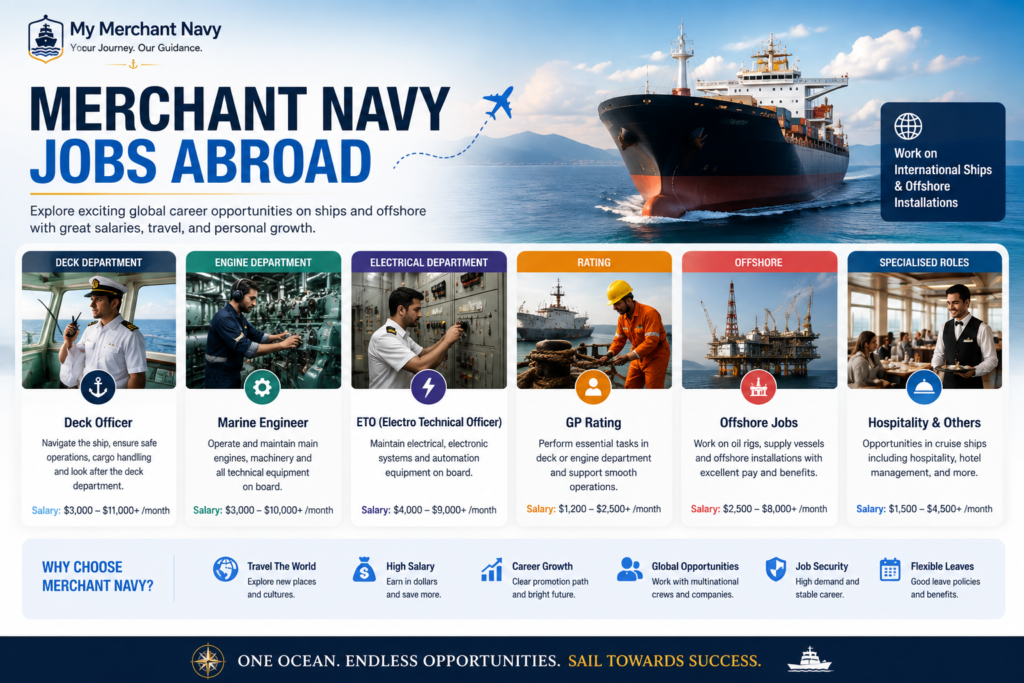
One of the biggest draws of a merchant navy career is that it was never really a “local” job to begin with. Indian officers and ratings crew foreign-flagged tankers, container ships, and bulk carriers all over the world, and Indian seafarers are widely regarded as among the most technically competent and reliable crew in the global shipping industry. But “working abroad” in the merchant navy doesn’t mean the same thing everywhere — a posting on a foreign-flagged vessel is very different from actually being employed and based in a country like the UK, the USA, or the UAE. This guide breaks down what “merchant navy jobs abroad” really means, and what’s specifically true for three of the most-asked-about destinations: the USA, the UK, and Dubai.
For most Indian seafarers, “working abroad” happens in one of three ways:
With that framing in mind, here’s what each of these three regions specifically means for an Indian seafarer.
This is the one with the biggest misconception attached to it, so it’s worth addressing directly: most Indian seafarers cannot work on US-flagged ships.
The reason is the Jones Act (the Merchant Marine Act of 1920), a US federal law that requires any vessel carrying cargo between two US ports to be American-built, American-owned, and American-crewed. Under the Jones Act:
In practice, this locks foreign nationals — including Indian seafarers — out of Jones Act vessels almost entirely, unless they hold US citizenship or a green card.
What’s actually available for Indian seafarers connected to the USA:
If a job posting promises a “Merchant Navy job in USA” for Indian freshers on US-flagged vessels, treat it with real skepticism — it usually misrepresents what the Jones Act actually allows.
The UK is a genuinely significant destination for Indian seafarers — not usually as a place of residence, but as a source of one of the most respected certifications in the industry: the UK Certificate of Competency (CoC), issued by the Maritime and Coastguard Agency (MCA).
Why Indian officers pursue a UK CoC:
What’s involved in getting a UK CoC:
Note on working IN the UK, not just holding UK papers: post-Brexit, actual UK-based employment (rather than sailing internationally with a UK CoC) generally requires a visa route such as the Skilled Worker visa, and UK employers now prioritize UK citizens first. UK CoC holders can — and mostly do — serve on vessels registered anywhere in the world without ever needing UK residency.
Dubai (and the wider UAE) occupies a different role in a seafarer’s career path — it’s less about a specific certificate and more about being one of the world’s major shipping, crewing, and ship-management hubs, especially for seafarers looking to eventually transition ashore.
What’s actually available in Dubai:
Why experienced officers specifically target Dubai for shore transitions: having spent years sailing, many Chief Engineers and Captains use their sea experience to move into shore-based superintendent or fleet management roles — and Dubai’s concentration of shipping and crew management companies makes it one of the most active markets for exactly this kind of transition.
On taxation: the UAE does not levy personal income tax on salaries, so shore-based earnings in Dubai are generally tax-free at the source — separate from (and simpler than) the NRI tax-residency rules that apply to seafarers sailing internationally on foreign-flagged vessels.
Regardless of which region you’re connected to, one rule applies broadly across the merchant navy: seafarers who spend 183 days or more outside India in a financial year typically qualify for NRI tax status, making the bulk of their sea-based income tax-free in India. This is true whether you’re sailing on a foreign-flagged vessel that touches US ports, holding a UK CoC, or crewed through a Dubai-based management company — the tax treatment depends on your residency status and days at sea, not on which country’s flag or certificate is involved. We’d recommend confirming your specific situation with a CA who specializes in seafarer taxation, since individual circumstances vary.
Generally, no. The Jones Act requires officers on US-flagged vessels in domestic trade to be US citizens, and even unlicensed crew are capped at 25% permanent residents. Indian seafarers typically work on foreign-flagged vessels that call at US ports instead, which is unrestricted.
Neither is objectively “better” — both are internationally recognized, and India and the UK have a mutual recognition agreement for CoCs. A UK CoC can be an advantage with certain international employers, but it comes with additional sea-time and exam requirements on top of your Indian qualifications.
Both sea-based roles with Dubai-headquartered shipping and crewing companies, and shore-based roles like Technical Superintendent, Marine Superintendent, and Fleet Manager — Dubai is particularly strong as a hub for seafarers transitioning from sea to shore careers.
For most seafarers who spend 183+ days outside India in a financial year, sea-based income qualifies for NRI tax status and is largely tax-free in India. Shore-based income in a country like the UAE is also typically free of personal income tax at source. Specific rules vary by individual circumstance.
.