
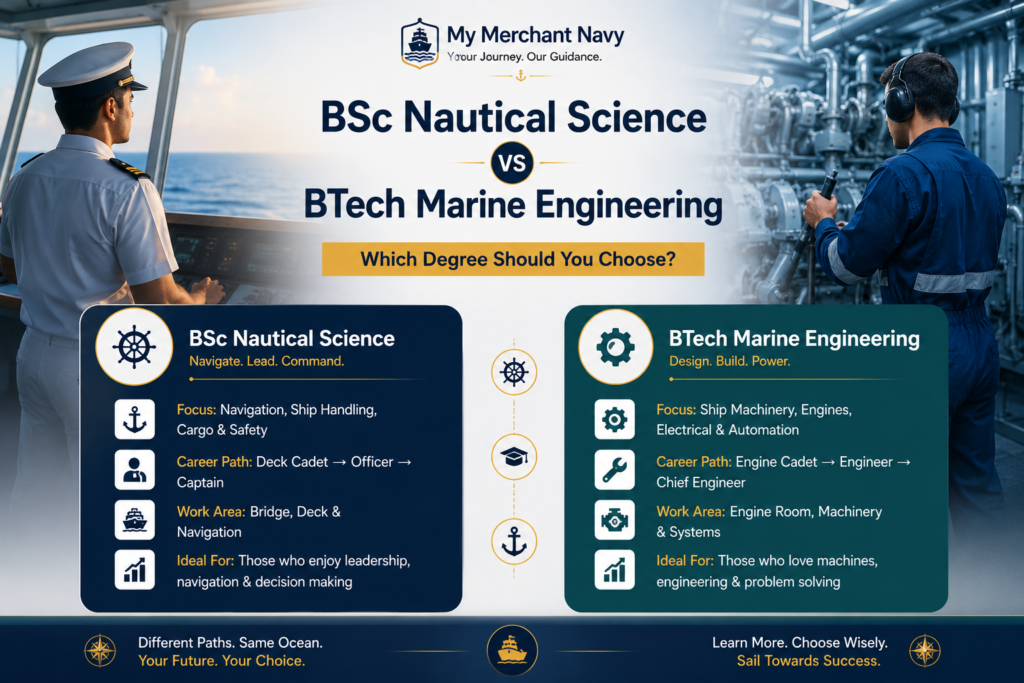
BSc Nautical Science is a 3-year, DG Shipping-approved undergraduate degree that trains you for the deck/navigation side of a ship. It’s the degree-level equivalent of DNS (Diploma in Nautical Science) — same career destination, but spread over three years instead of one, with a full Bachelor’s degree at the end of it.
The curriculum covers navigation, seamanship, ship operations, meteorology, maritime law, and — notably — enough marine engineering fundamentals to give you a well-rounded understanding of how the ship works as a whole. Graduates sail as Deck Cadets and progress through Third Officer, Second Officer, Chief Officer, and eventually Captain (Master Mariner).
BSc Nautical Science eligibility:
One practical advantage worth noting: BSc Nautical Science graduates do not need to complete a separate foundation course before appearing for their Second Mate certification exam — something DNS graduates typically do need, since DNS is a shorter one-year program.
BTech Marine Engineering is a 4-year, AICTE and DG Shipping-approved engineering degree that trains you for the engine/technical side of a ship. It’s the degree-level counterpart to GME (Graduate Marine Engineering), but instead of converting an existing mechanical engineering graduate, BTech Marine Engineering builds the engineering foundation and the maritime specialization together from 12th grade onward.
The curriculum covers marine engines, thermodynamics, ship auxiliary machinery, naval architecture basics, electrical and electronic systems, and workshop practice. Graduates sail as Junior Engineers and progress through Fourth Engineer, Third Engineer, Second Engineer, and eventually Chief Engineer.
BTech Marine Engineering eligibility:
Factor | BSc Nautical Science | BTech Marine Engineering |
Duration | 3 years | 4 years |
Department | Deck / Navigation | Engine / Technical |
Degree type | Bachelor of Science | Bachelor of Technology |
Entrance exam | IMU CET (or CUET at some institutes) | IMU CET, JEE Main, or state CETs |
Entry rank onboard | Deck Cadet | Junior Engineer |
Top career rank | Captain (Master Mariner) | Chief Engineer |
Course fees | ₹2–7 lakh per year | ₹4 lakh (government) to ₹24 lakh (private) total |
Foundation course after cadetship | Not required before 2nd Mate exam | Standard progression through engineering CoC exams |
Both degrees put you on an officer track from day one — a meaningful advantage over non-degree routes like GP Rating, where you start as a rating rather than an officer cadet.
BSc Nautical Science graduates sail as Deck Cadets, clear their Second Mate (Foreign-Going) Certificate of Competency, and move up through Third Officer, Second Officer, and Chief Officer before reaching Captain — typically over 10 to 12 years, depending on how quickly you clear each CoC exam.
BTech Marine Engineering graduates sail as Junior Engineers, clear their engineering CoC exams, and move up through Fourth, Third, and Second Engineer before reaching Chief Engineer — usually on a similar 8-to-10-year timeline.
The real difference isn’t the speed of promotion — it’s the nature of the work. Deck officers are responsible for navigation, cargo, watchkeeping, and ultimately commanding the vessel. Marine engineers are responsible for the engines, power generation, and every mechanical and electrical system that keeps the ship running.
Both degrees converge on strong senior-level pay. Early progression and salary depend heavily on how quickly you clear your CoC exams and which shipping company sponsors your cadetship — top-tier sponsors like Maersk, MSC, and Chevron tend to offer stronger placement pay and faster-track cadetships regardless of which degree you hold.
As with all merchant navy careers, seafarers who spend 183+ days outside India in a financial year typically qualify for NRI tax status, making the bulk of this income tax-free.
BTech Marine Engineering has a wider fee range — government colleges can actually work out cheaper overall than a 3-year BSc Nautical Science degree, while premium private sponsorship-track colleges cost significantly more. Sponsorship-linked institutes often justify the higher fee with a near-guaranteed cadetship placement, which is worth factoring into the real cost-benefit.
Choose BSc Nautical Science if:
Choose BTech Marine Engineering if:
Neither is objectively better — BSc Nautical Science leads to a navigation and command career (Captain), while BTech Marine Engineering leads to a technical and engineering career (Chief Engineer). The right choice depends on whether navigation or machinery interests you more.
Both have strong placement records at reputable, DG Shipping-approved institutes. Placement quality depends more on the specific college and its shipping-company tie-ups (e.g., Maersk, MSC sponsorship tracks) than on the degree type itself.
It depends on the institute. BTech Marine Engineering at a government college (like MERI Mumbai or MERI Kolkata) can be cheaper than a 3-year BSc Nautical Science degree, but private, sponsorship-track BTech Marine Engineering colleges can cost significantly more than BSc Nautical Science.
At senior levels, Captains and Chief Engineers earn broadly comparable salaries. The bigger driver of long-term pay is how quickly you clear your CoC exams and the reputation of your sponsoring shipping company — not which of these two degrees you hold.
.