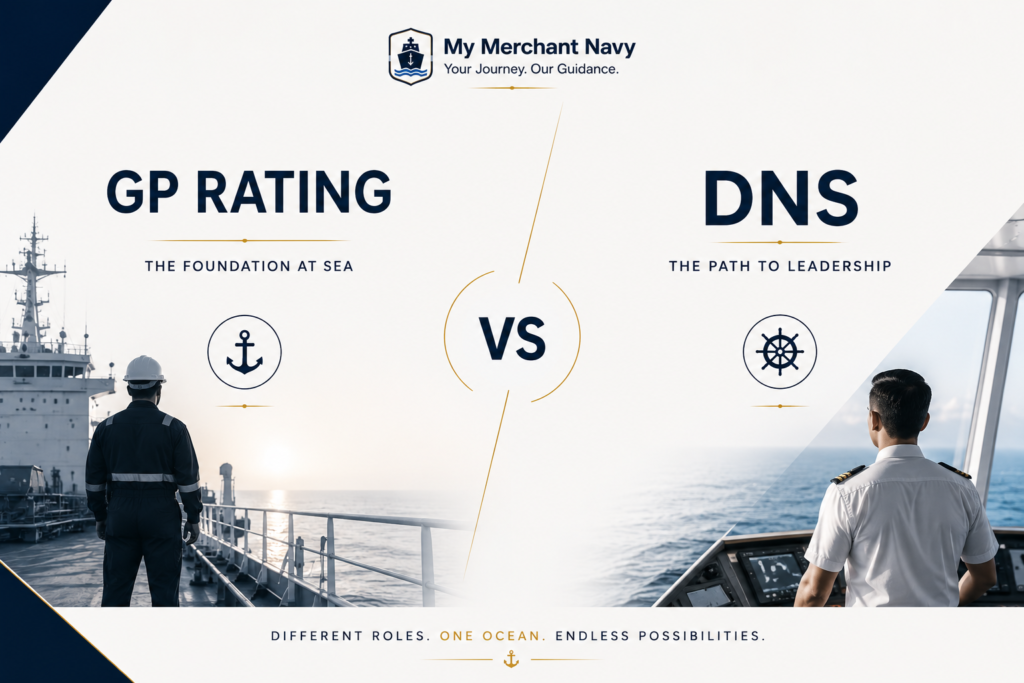
GP Rating (General Purpose Rating) is a 6-month, DG Shipping-approved residential pre-sea training program. It’s the most accessible entry point into the merchant navy because it requires only a 10th-grade pass — no PCM, no science stream, and open to students from any academic background.
GP Rating training covers a mix of deck and engine-room basics — seamanship, cargo handling, engine room maintenance, fire-fighting, and mandatory STCW safety courses — so graduates come out as “all-rounders” capable of working in either department onboard.
GP Rating eligibility:
After completing the course and clearing exams conducted by the Board of Examination of Seafarers (BES), candidates receive a CDC (Continuous Discharge Certificate) and can join ships as Ordinary Seaman, Wiper, or similar rating positions.
DNS (Diploma in Nautical Science) is a 1-year classroom program followed by mandatory sea training, leading directly to a career as a deck officer. Unlike GP Rating, DNS requires 12th-grade completion with Physics, Chemistry, and Mathematics (PCM), and candidates must clear the IMU Common Entrance Test (IMU CET) for admission.
DNS graduates join ships as Deck Cadets and, after completing their cadetship and clearing Certificate of Competency (CoC) exams, are promoted to Third Officer, then Second Officer, Chief Officer, and eventually Captain (Master Mariner).
DNS eligibility:
Factor | GP Rating | DNS |
Minimum qualification | 10th pass, any stream | 12th pass with PCM |
Course duration | 6 months | 1 year (plus mandatory sea time) |
Entrance exam | Not required | IMU CET |
Entry rank onboard | Rating (Ordinary Seaman, Wiper, etc.) | Officer (Deck Cadet → Third Officer) |
Top career rank | Senior Rating / can upgrade to officer later | Captain (Master Mariner) |
Course fees | ₹50,000–₹1.5 lakh | ₹2–5 lakh |
Age limit | 17.5–25 years | Up to 25 years |
This is where the two paths diverge the most. DNS puts you directly on the officer track — you start as a Deck Cadet and, provided you clear your CoC exams on schedule, can realistically reach Captain within about 10–12 years.
GP Rating starts you as a Rating, not an officer. However, it’s not a dead end — Ratings can gain sea experience and later write competitive exams to upgrade into the officer stream, though this route generally takes longer than starting directly through DNS. Many students use GP Rating as a low-cost, low-barrier way to get into the industry and test whether life at sea suits them, before deciding whether to invest further in officer-level qualifications.
In the short term, GP Rating and DNS cadet salaries are broadly comparable. But over the medium and long term, DNS produces officers who earn significantly more, since the officer track has a much higher salary ceiling than the rating track. As with all merchant navy roles, seafarers who spend 183+ days outside India in a financial year typically qualify for NRI tax status, making a large share of this income tax-free.
Cost is one of the biggest practical differences between the two courses:
For families where budget is the primary constraint, GP Rating offers a much more affordable entry into the merchant navy, with the option to upgrade later.
Choose GP Rating if:
Choose DNS if:
Yes. Ratings can gain sea experience and later appear for competitive exams to move into the officer stream, though this path generally takes longer than entering directly through DNS.
Yes. Unlike DNS, GP Rating does not require PCM and is open to students from any academic stream after 10th grade.
DNS leads to significantly higher long-term earning potential, since it puts you directly on the officer track, which has a much higher salary ceiling (up to ₹10–20 lakh+ per month at the Captain level) than the rating track.
No. GP Rating does not require an entrance exam like the IMU CET that DNS candidates must clear. Admission is generally based on 10th-grade marks and meeting medical fitness standards.
.