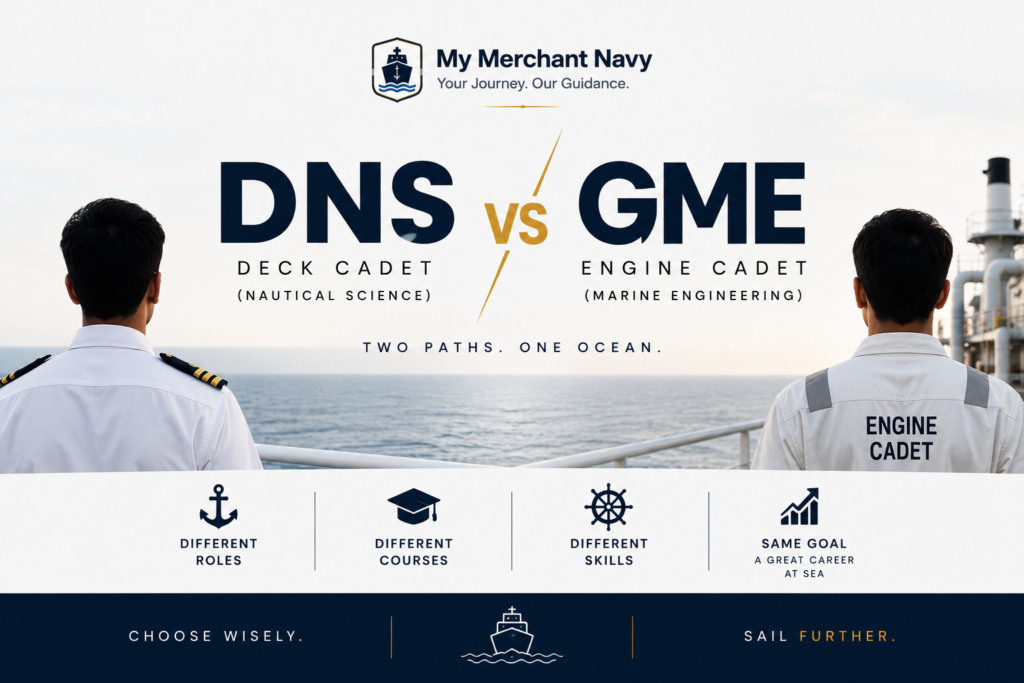
Choosing between DNS (Diploma in Nautical Science) and GME (Graduate Marine Engineering) is one of the biggest decisions you’ll make before starting a career in the merchant navy. Both are DG Shipping-approved pre-sea training programs, both lead to officer-level careers on commercial ships, and both offer strong salaries and global exposure — but they take you down completely different paths.
DNS puts you on the navigation/deck side of a ship, working your way up to Captain. GME puts you on the engineering side, working your way up to Chief Engineer. This guide breaks down the DNS vs GME comparison in detail — eligibility, course structure, career progression, salary, and cost — so you can make an informed decision.
DNS is a one-year residential pre-sea training program approved by DG Shipping and affiliated with the Indian Maritime University (IMU). It is one of the most popular entry routes into the merchant navy for students who want to work on the deck/navigation side of a ship.
After completing DNS, cadets sail as Deck Cadets and, through a mix of onboard sea time and further certification exams, progress through the ranks: Third Officer, Second Officer, Chief Officer, and eventually Captain (Master Mariner).
DNS eligibility:
GME is a one-year pre-sea training program designed specifically for engineering graduates who want to move into a career on the engine side of a ship. It essentially acts as a conversion course, helping mechanical engineers (and naval architecture graduates) transition into marine engineering.
After GME, cadets sail as Junior Engineers and progress through the ranks: Fourth Engineer, Third Engineer, Second Engineer, and eventually Chief Engineer.
GME eligibility:
This is the key structural difference in the DNS vs GME comparison: DNS is open to 12th-pass students, while GME requires you to already hold an engineering degree.
Both DNS and GME are one-year programs, but the content is entirely different:
After classroom training, both streams require mandatory sea time onboard ships before cadets can appear for further Certificate of Competency (CoC) exams that unlock promotions.
Stage | DNS (Deck Side) | GME (Engine Side) |
Entry rank | Deck Cadet | Junior Engineer |
Mid-level | 2nd Officer / Chief Officer | 3rd Engineer / 2nd Engineer |
Top rank | Captain (Master Mariner) | Chief Engineer |
Typical time to top rank | Around 10 years | Around 8–10 years |
Both career paths offer strong long-term growth, and both eventually converge on similar earning potential once you reach the top rank. The real difference is the nature of the work: DNS/deck officers are responsible for navigation, cargo, and overall command of the vessel, while GME/engine officers are responsible for keeping the ship’s machinery, engines, and power systems running.
Merchant navy salaries vary by rank, company, vessel type, and experience, but here’s a general benchmark for 2026:
For most seafarers who spend more than 182 days outside India in a financial year, income qualifies for NRI status and is largely tax-free — a major advantage of a merchant navy career over most shore-based jobs, regardless of whether you choose DNS or GME.
Cost is often the deciding factor for many students comparing DNS and GME:
Since GME candidates already hold an engineering degree, the total cost of becoming a marine engineer (degree + GME) is generally higher than the total cost of the DNS route, which can begin right after 12th grade.
There’s no universally “better” option — the right choice depends on your background and interests:
Choose DNS if:
Choose GME if:
Neither is objectively better — DNS leads to a navigation/command career (Captain), while GME leads to an engineering career (Chief Engineer). The right choice depends on whether you’re more interested in navigation or machinery, and whether you already hold an engineering degree.
No. Once you begin sea time and certification exams in one department (deck or engine), switching departments generally means starting the training process again in the new stream.
Starting salaries for DNS and GME cadets are similar. At senior ranks, both Captains and Chief Engineers earn comparable salaries, with variation depending on company, vessel type, and experience rather than which course you chose.
DNS requires 12th with PCM directly. GME requires a completed engineering degree (which itself usually required PCM in 12th), so PCM is effectively a prerequisite for both paths, just at different stages.
.