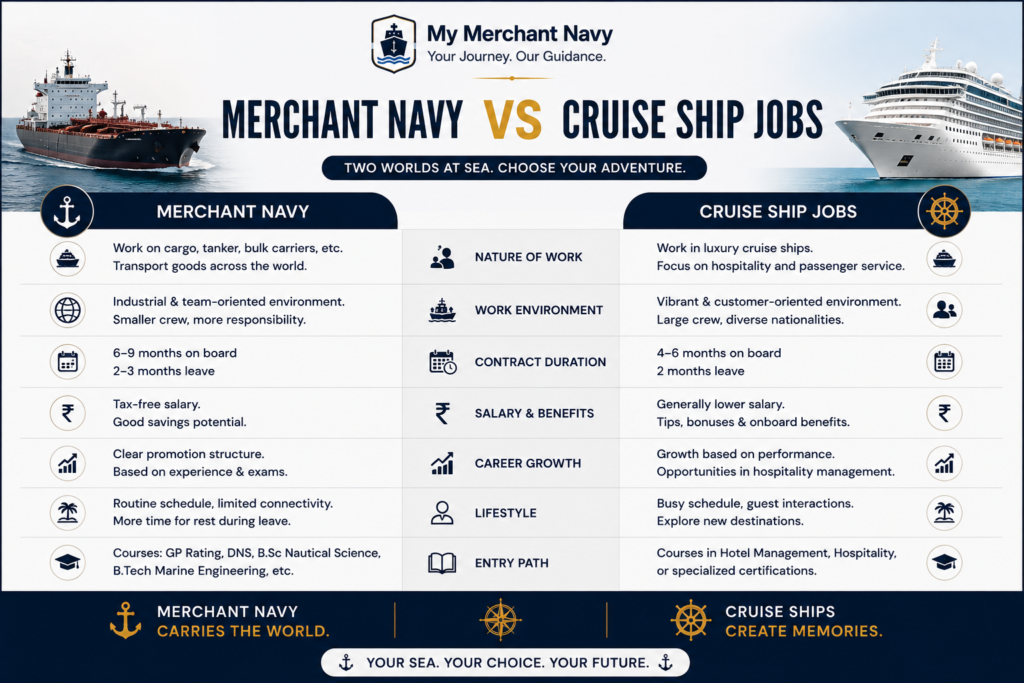
When people ask “merchant navy or cruise ship,” they usually mean: should I aim for cargo/tanker vessels (the traditional merchant navy image — container ships, bulk carriers, oil tankers) or cruise/passenger vessels specifically. Both require the same foundational qualifications — BSc Nautical Science, BTech Marine Engineering, DNS, or GP Rating, admitted through IMU CET or company sponsorship, regulated by DG Shipping. The difference lies entirely in which vessel type you end up sailing on, and that choice has real consequences for pay, lifestyle, and day-to-day work.
Rank | Cargo/Tanker Vessels | Cruise Ships |
Junior Officer (3rd/4th Officer-Engineer) | $2,500–4,500/month | $3,000–5,000/month |
Chief Officer / Senior Officer | $6,000–10,000/month | $6,000–8,500/month |
Captain | $80,000–140,000/year ($6,700–11,700/month) | $120,000–200,000+/year ($10,000–16,700+/month) |
Cruise ship captains earn meaningfully more than cargo captains at the top of the ladder — the gap reflects genuinely different operational scope. A large cruise ship carries 3,000–7,000 passengers and functions as a floating resort; the captain manages navigation, crew safety, passenger relations, port coordination across multiple jurisdictions, and carries far greater liability than a cargo captain overseeing a crew that numbers in the dozens rather than thousands of passengers.
At junior and mid-officer levels, the pay gap is smaller and sometimes favours cruise roles slightly, though gas carriers and chemical tankers in the cargo world can still out-pay cruise positions at equivalent seniority, since specialised cargo risk commands its own premium.
Factor | Cargo/Tanker Vessels | Cruise Ships |
Typical contract length | 3–9 months | 4–8 months |
Leave between contracts | 2–4 months, paid | Varies by cruise line, generally shorter than cargo-vessel leave blocks |
Offshore Support Vessels (comparison point) | 2–3 months (shorter but often higher-paying) | — |
Cruise contracts tend to run slightly shorter on average than cargo/tanker contracts, though both fall in a broadly similar 3–9 month range depending on company and role.
On cargo/tanker vessels, the job is almost entirely operational — navigation, cargo handling, engine maintenance, safety drills — with a small crew (often a few dozen people) and minimal passenger-facing responsibility. The work is technical and process-driven, and officers spend the bulk of their time on core ship-operation duties.
On cruise ships, officers take on the same core navigation/engineering responsibilities, but with an added, substantial layer: managing passenger safety, comfort, and satisfaction for thousands of people simultaneously. This is also where cruise ships introduce departments that don’t really exist on cargo vessels — hospitality and catering roles overseeing food service, housekeeping, guest services, and entertainment operations are a genuine career track unique to passenger vessels, alongside the standard deck and engine departments.
Factor | Cargo/Tanker Vessels | Cruise Ships |
Crew size | Dozens | Hundreds to over a thousand crew, thousands of passengers |
Work environment | Industrial, operational, quiet | Social, service-oriented, higher energy |
Isolation level | Higher — limited social interaction beyond crew | Lower — constant interaction with passengers and large crew community |
Port variety | Often industrial ports, less tourist-friendly | Popular tourist destinations, more appealing shore leave |
Physical environment | Confined working spaces, engine room/deck conditions | More amenities on board (crew facilities vary by cruise line, but generally more extensive) |
For someone specifically seeking less isolation and more social interaction at sea, cruise ships offer a meaningfully different day-to-day environment than cargo vessels — the trade-off being a more service-oriented, passenger-facing job even in navigation and engineering roles.
Tax treatment doesn’t change based on whether you’re on a cargo vessel or a cruise ship — what matters under Indian tax law is your NRI status, determined by spending 183+ days outside India in a financial year, which most active seafarers meet regardless of vessel type given standard contract lengths. Where it can get more complex is for officers on cruise lines that are foreign-flagged and operate primarily out of non-Indian home ports (common for major international cruise brands) — the underlying NRI qualification logic is the same, but it’s worth confirming your specific line’s operational pattern with a tax advisor familiar with seafarer taxation, since day-count tracking across multiple short port calls can differ slightly in complexity from a cargo vessel’s longer, more continuous voyages.
Yes — cruise ships are commercial passenger vessels regulated under the same DG Shipping/IMU framework as cargo ships and tankers; “cruise ship jobs” refers to a vessel-type choice within the merchant navy, not a separate career.
At the Captain level, generally yes — cruise captains earn meaningfully more due to the scale of passenger responsibility. At junior and mid-officer levels, the gap is smaller and specialised cargo vessels (gas carriers, chemical tankers) can match or exceed cruise pay.
Both typically run 3–9 months, though cruise contracts trend slightly shorter on average (4–8 months) compared to cargo/tanker vessels, and offshore support vessels are shorter still (2–3 months).
Generally yes, since both draw from the same qualification and CoC structure, though moving between the two does typically require additional vessel-type-specific familiarisation and, for cruise ships, sometimes passenger-vessel-specific training.