
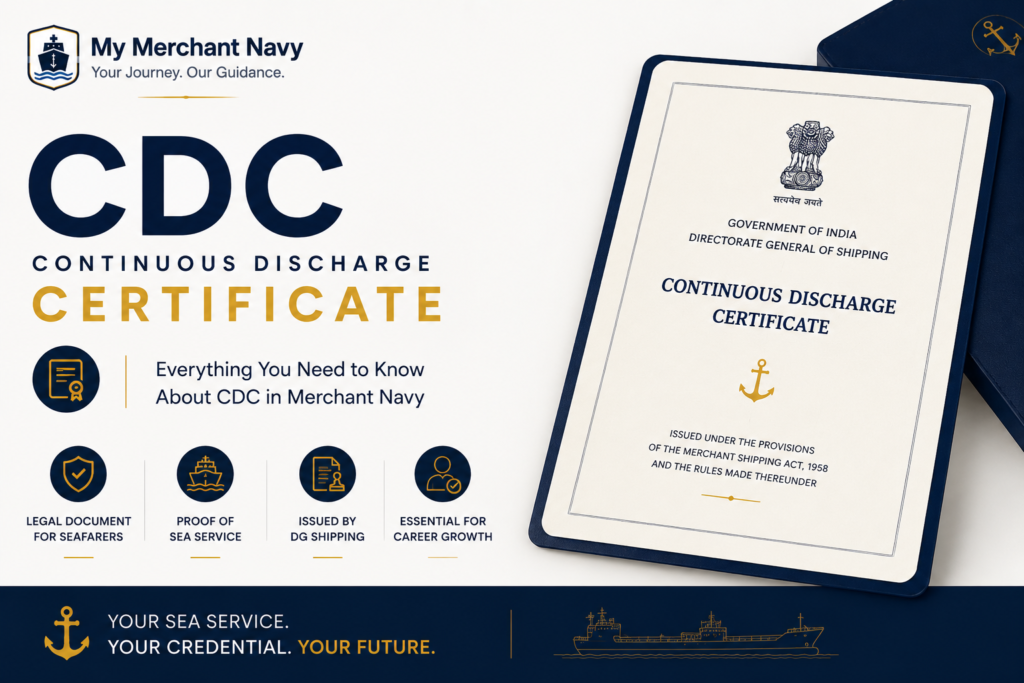
A Continuous Discharge Certificate (CDC), also called a Seaman’s Book, is the official identity and service-record document issued to Indian seafarers by the Directorate General of Shipping (DGS), Government of India. Think of it as a professional passport for the sea — it records every contract, every discharge and engagement from a vessel, and serves as the authoritative document used to calculate a seafarer’s total sea service. Without a CDC, you cannot legally join a commercial vessel, get your sea time recognised, or draw pay for sea service. Rank promotions and Certificate of Competency (CoC) eligibility both depend directly on the sea-service entries recorded in your CDC.
CDCs are issued by the Shipping Master at Government Shipping Offices located in Mumbai, Chennai, and Kolkata — allied offices of the DGS operating under the Mercantile Marine Department.
Applicants should be aware of a significant regulatory change: under DGS Order 12 of 2026, effective 1 August 2026, the eligibility requirements for an Indian CDC have tightened. Previously, completion of the five Basic STCW courses alone was sufficient grounds for CDC eligibility — as of this order, that is no longer the case on its own. Additionally, new Merchant Shipping (Continuous Discharge Certificate) Rules, 2026 have been notified under the Merchant Shipping Act, 2025, superseding the earlier 2017 CDC rules. Given how recent these changes are, applicants should verify the exact current eligibility criteria directly on the DGS portal (dgshipping.gov.in) before applying, rather than relying solely on pre-2026 guides — including older sections of this one, since rules of this kind are still settling into standard practice industry-wide.
Under the framework in effect as of 2026:
The CDC application fee is commonly cited at ₹700, payable online via the DGS portal’s payment gateway (net banking, UPI, or card), though a few sources report a broader ₹700–1,000 range depending on the specific service (fresh issuance, renewal, or duplicate). This fee is generally non-refundable — applicants are advised to double-check all documents and details carefully before submission to avoid paying the fee multiple times over rejected or incomplete applications.
Under the 2017 rules, a CDC was valid for 10 years from issuance, renewable on expiry or within a window before expiry. However, given the notification of new Merchant Shipping (CDC) Rules, 2026, validity periods and renewal procedures may have been revised — always confirm the current validity period directly with DGS rather than relying on the older 10-year figure without verification. If a CDC’s validity period expires mid-voyage, it generally remains valid until the end of that voyage under the applicable rules, though this too is worth confirming under the current 2026 framework.
If your CDC is lost, the process generally involves:
Duplicate CDC processing follows a similar verification process to a fresh application, so expect a comparable timeline.
First-time applicants sometimes conflate the CDC with the INDoS number, but they serve distinct purposes. The INDoS (Indian National Database of Seafarers) number is a unique lifetime registration ID assigned to every Indian seafarer, functioning as a prerequisite identifier used across almost all subsequent documentation — including the CDC application itself. The CDC, by contrast, is the physical booklet-format document that actually records sea service, contracts, and discharge/engagement history over time. In short: you need an INDoS number before you can apply for a CDC, but the two documents are not interchangeable, and losing or renewing one does not affect the other.
CDC stands for Continuous Discharge Certificate — the identity and sea-service record document issued to Indian seafarers by the Directorate General of Shipping.
Yes — it’s mandatory to legally join any commercial vessel and to have sea service officially recognised.
Commonly cited at ₹700, payable online through the DGS portal, though it is applied by the pre sea training institute in most cases.
Typically 15–30 working days after successful in-person verification at a Government Shipping Office, though processing times vary and can be tracked via the DGS portal.