Getting into the merchant navy isn’t just about clearing IMU CET and picking a college — for most cadets, which shipping company sponsors your training matters just as much. Sponsorship guarantees placement on a ship after training, often covers part of your fees, and removes the post-course scramble for a job that non-sponsored candidates face. This guide covers the major shipping companies actively sponsoring Indian cadets, what each looks for, and how the sponsorship process works.
Sponsorship is a pre-placement guarantee from a shipping company — it commits to funding or subsidising your maritime training and, in exchange, guarantees you a job on board one of its vessels after successful course completion, typically bonded for 2–3 years of service afterward. Sponsored cadets generally get guaranteed sea time and face far fewer placement difficulties than non-sponsored candidates, who must independently search for a company willing to sign their Training Record Book once training is complete. Sponsorship isn’t legally mandatory to enter the merchant navy, but it’s widely considered the more secure and recommended route, especially for first-time applicants without existing industry connections.
One of the world’s largest and most reputed ship management companies, overseeing a fleet of 600–700+ vessels globally. Anglo-Eastern’s sponsorship is highly competitive, typically requiring minimum 70% marks in PCM (75% for improvement candidates). Training runs through its own Anglo-Eastern Maritime Academy (AEMA) in Karjat, near Mumbai, covering Deck Cadet and ETO tracks.
The largest container shipping line globally, operating over 570 container vessels across more than 215 trade routes. MSC’s sponsorship covers DNS and BTech programs, requiring candidates to clear IMU CET, meet age/academic criteria, and pass DG Shipping medical requirements. MSC is affiliated with numerous DG-approved institutes across India.
A.P. Moller–Maersk, one of the world’s largest container logistics companies, has shifted its India approach in recent years toward institutional partnerships — notably with AMET University — including specific programs supporting women in maritime careers, alongside management trainee and internship pathways, rather than direct individual cadet sponsorship as it ran previously.
One of India’s largest private shipping companies, running its own training institute — The Great Eastern Institute of Maritime Studies (GEIMS), Lonavala. Offers sponsorship for GP Rating, Diploma in Nautical Science, and ETO programs, with candidates required to clear exams and interviews before receiving sponsorship and connected on-ship training.
Sponsors cadets across multiple maritime institutes for various courses, known for a broad, multi-institute sponsorship footprint rather than running a single dedicated academy.
Offers one of the more competitive sponsorship programs in the sector, with strong ties to several established training institutes.
India’s government-owned shipping company, running its own Maritime Training Institute (MTI) with campuses in Mumbai and Tuticorin. SCI recruits directly through its own selection scheme, offering a distinct government-backed sponsorship route separate from the private-company options above.
Trains and recruits almost entirely in-house through its dedicated training centre, Samundra Institute of Maritime Studies (SIMS), Lonavala — over 80% of ESM-managed vessels’ officers reportedly come from cadets trained at SIMS, with the company aiming to eventually crew its entire fleet with in-house-trained officers.
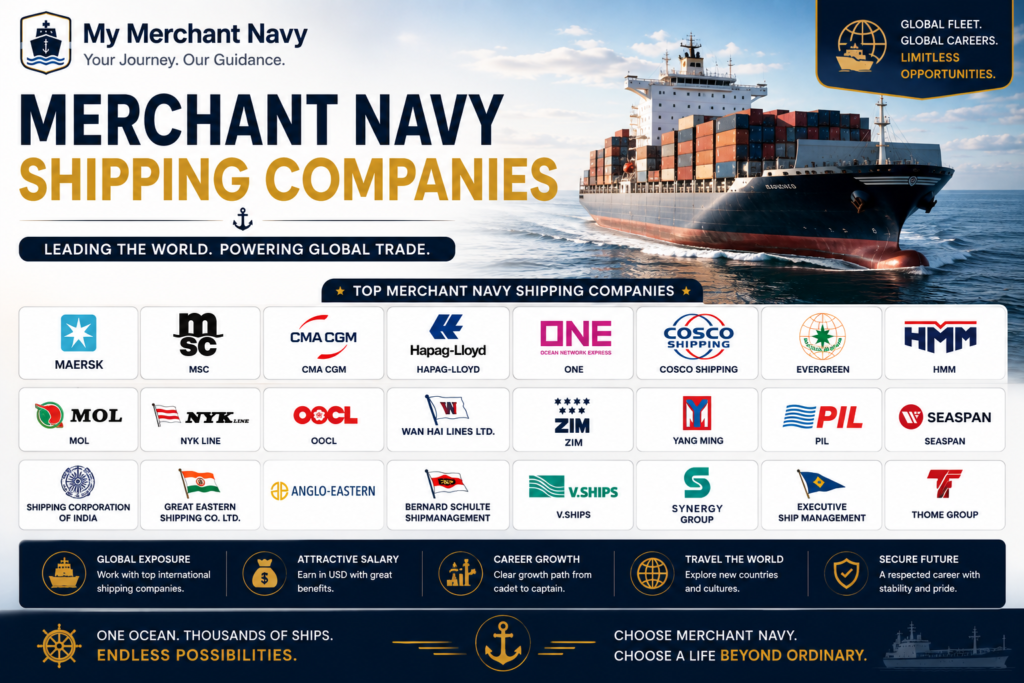
V.Ships, TORM Tankers, Wallem Group, Bernhard Schulte Shipmanagement (BSM), and Scorpio are also regularly cited among companies conducting sponsorship exams and recruiting Indian cadets, each with their own institute affiliations and selection criteria.
Factor | Sponsored Cadet | Non-Sponsored Cadet |
Job guarantee after training | Yes, typically bonded to the sponsoring company | No — must independently secure a company to sign your TRB |
Fee support | Often partial or full tuition coverage | Full fees typically self-funded |
Placement uncertainty | Low | Higher — placement depends entirely on individual effort post-training |
Flexibility to choose employer later | Limited during bond period | Full flexibility from the start |
Sponsorship trades some flexibility for security — a fair trade-off for most first-time cadets, particularly those without existing industry contacts.
There’s no single “best” sponsor — the right fit depends on your target vessel type and career goals. If you’re drawn to container shipping, MSC or Maersk-affiliated programs are natural fits. If tankers or gas carriers interest you long-term, companies like TORM or Synergy’s broader fleet exposure may align better. If you want a government-backed, more stable route, SCI’s Maritime Training Institute is worth considering over private sponsors. Research each company’s actual fleet composition and typical vessel assignments — not just their brand recognition — before committing to a sponsorship exam.
No, it’s not legally mandatory, but it’s widely recommended since it guarantees placement and removes the post-training job search that non-sponsored candidates face.
There’s no universally “easiest” company — competitiveness varies by cycle and candidate pool, though companies with a broader multi-institute sponsorship footprint (like Synergy) may offer more entry points than single-academy sponsors with stricter cutoffs (like Anglo-Eastern).
Maersk has shifted toward institutional partnerships (notably with AMET University) and management trainee programs rather than the direct individual cadet sponsorship it ran previously — confirm the current program structure directly with Maersk or AMET before applying.
You can still complete pre-sea training independently through BSc Nautical science and then get placed during final year recruitment drive