
GP Rating (General Purpose Rating) is the fastest, most affordable entry into the merchant navy — open to 10th-pass students, with just 6 months of pre-sea training standing between you and your first ship. This guide covers what GP Ratings actually earn at every stage, how pay grows with experience, and how it compares to the officer track.
A General Purpose Rating is a versatile crew member trained to assist in both the deck and engine departments — handling maintenance, cargo operations support, watchkeeping assistance, and general vessel duties under the supervision of officers. It’s the non-officer entry route into the merchant navy: no PCM background or engineering degree required, just a 10th-pass certificate and a DGS-approved 6-month pre-sea training course. GP Ratings work their way up through a defined rating hierarchy, and while the pay ceiling is lower than the officer track, it’s a genuinely accessible and respectable career path — particularly for students from modest financial backgrounds, since the course itself costs a fraction of a degree program.
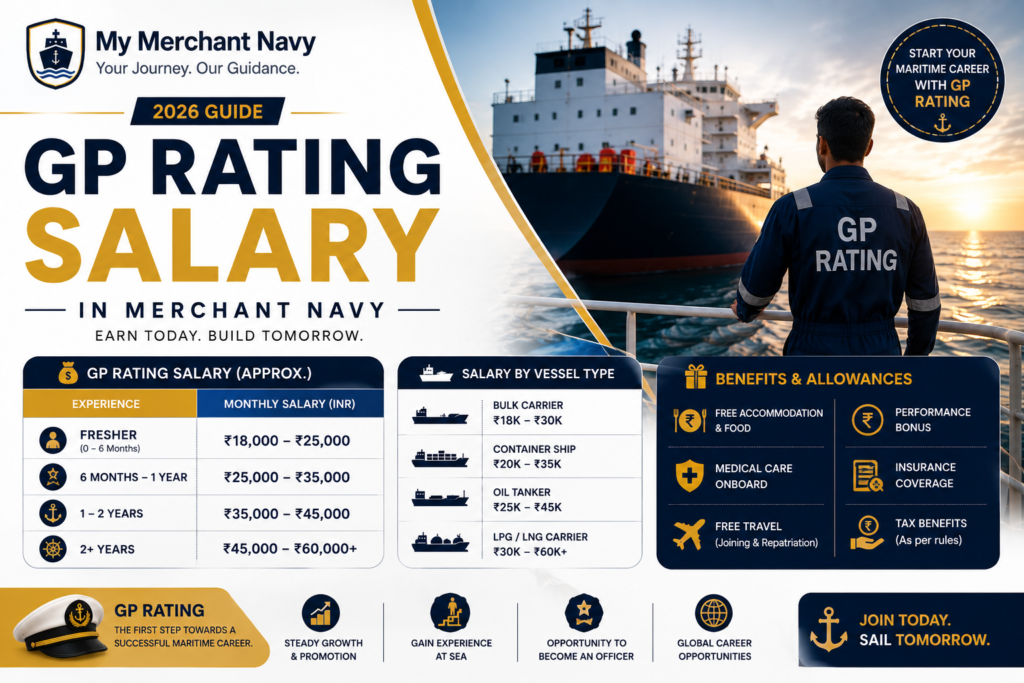
Stage/Rank | Approx. Monthly Salary (Indian-flagged vessels) | Notes |
GP Rating (Trainee/fresher) | ₹25,000–50,000 | Wide range reported across sources; foreign-going vessels can pay $300–600/month equivalent |
Ordinary Seaman (OS) | ₹40,000–75,000 | First promotion after gaining sea time and experience |
Able Seaman (AB) | ₹60,000–1,00,000+ | On international ships, ABs report earning ₹1 lakh+/month within 2–3 years |
Bosun / Deck Fitter | ₹1,00,000–1,60,000 | Senior rating position, effectively leading the ratings crew |
As with every merchant navy pay figure, ranges vary meaningfully by source, company, and whether the vessel is Indian-flagged or foreign-going — foreign companies generally pay noticeably more than domestic Indian shipping companies at every rating level.
A few factors explain why GP Rating pay reports vary by nearly 2x across sources:
Since this is covered in depth in our dedicated GP Rating course article, the key salary-relevant point is simply this: no PCM background, no engineering or nautical science degree, and no IMU CET are required — just the 6-month course and DGS medical clearance.
The GP Rating route offers genuinely faster, cheaper entry, but the long-term earning ceiling is meaningfully different from the officer track:
Track | Starting Salary | Peak Salary (senior rank) |
GP Rating → Ordinary Seaman → AB → Bosun | ₹25,000–50,000 | ₹1–1.6 lakh/month |
Deck Cadet → Third Officer → Chief Officer → Captain | ₹25,000–85,000 | ₹8.5–20 lakh/month |
Engine Cadet → Fourth Engineer → Second Engineer → Chief Engineer | ₹25,000–85,000 | ₹8.5–20 lakh/month |
This isn’t a reason to dismiss the GP Rating route — for a 10th-pass student without the PCM background or finances for a degree program, it’s a genuinely strong entry point into a respectable, tax-advantaged career. But it’s worth being upfront with students and parents that the pay ceiling is structurally lower than the officer track, since ratings don’t sit the Certificate of Competency exams that unlock officer-level pay. Some ratings do progress toward officer-level qualifications later through further courses and sea time, which is worth exploring if long-term earning potential is the priority.
Like officers, GP Ratings qualify for NRI tax-exempt status on their seafarer income if they spend 183+ days outside India in a financial year, under Section 5 of the Income Tax Act. This applies at every rank, including entry-level GP Rating positions on foreign-going vessels, making the effective take-home pay somewhat higher than the headline figure suggests once the tax savings are factored in.
If you’re a 10th-pass student weighing the GP Rating route, here’s a grounded expectation: your first year or two will likely fall in the ₹25,000–45,000/month range on an Indian-flagged vessel, with meaningful jumps as you move from Trainee to Ordinary Seaman to Able Seaman over roughly 3–5 years of accumulated sea time. Landing a foreign-going vessel or a larger international company earlier in your career — rather than staying exclusively on Indian-flagged ships — is the single biggest lever available to a rating for accelerating that growth, based on the pay gaps reported consistently across sources.
Since GP Rating admission has no academic entrance exam gatekeeping it the way IMU CET does for officer-track courses, placement and pay progression end up depending more heavily on soft factors — physical fitness, discipline, and interview performance at the sponsoring company’s selection stage. Institutes with strong placement ties to specific shipping companies (similar to the sponsorship model seen at officer-track academies) tend to place freshers on better-paying foreign-going vessels faster than institutes without those relationships. It’s worth asking any GP Rating training institute directly about their actual placement track record and which companies they sponsor into, rather than relying on the course fee or brand name alone, since that placement pipeline has a bigger effect on starting pay than almost anything else at this level.
It’s worth placing GP Rating pay alongside the other entry-level tracks side by side, since prospective students often weigh all three at once. ETO Cadets typically start around ₹30,000–50,000 per month, similar to GP Rating and Deck/Engine Cadet starting ranges — the meaningful divergence only appears a few years in, once officer-track candidates clear their first Certificate of Competency exam and jump to ₹1.5–3.8 lakh/month, while ratings progress more gradually through the Ordinary Seaman and Able Seaman stages. For a student deciding purely on entry-level pay, the three tracks look similar in year one; the real decision point is the multi-year earning trajectory each path unlocks.
Commonly reported between ₹25,000–50,000 per month on Indian-flagged vessels for freshers, with foreign-going vessels potentially paying more.
Ratings can pursue further courses and accumulate additional sea time to work toward officer-level qualifications, though this is a longer and less direct path than starting on the Deck Cadet or Engine Cadet track after 12th.
Yes, GP Ratings qualify for the same NRI tax-exempt status as officers if they spend 183+ days outside India in a financial year, under Section 5 of the Income Tax Act.
Senior rating positions like Bosun or Deck Fitter are commonly reported in the ₹1,00,000–1,60,000 per month range, reflecting several years of accumulated experience and certifications.