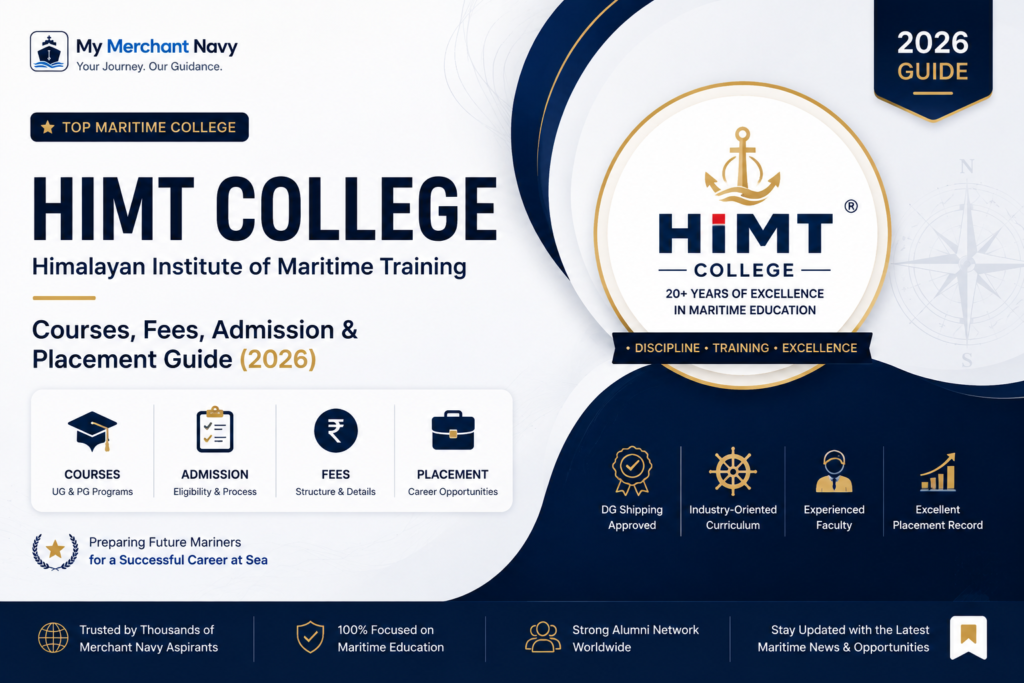
Hindustan Institute of Maritime Training (HIMT) is a private maritime institute established in 1998 by Mr. Sanjeev S. Vakil, headquartered in Kilpauk, Chennai, with additional campuses in Tidel Park (Chennai), Kalpakkam, and Visakhapatnam. HIMT is affiliated with Indian Maritime University (IMU) and approved by the Directorate General of Shipping (DGS). It has been rated SMERA Grade 1 (Outstanding) across its courses, and is notably the only Indian maritime institute rated by all four DG Shipping-approved rating agencies — SMERA, CRISIL, ICRA, and CARE. HIMT also holds ClassNK Grade A1 certification and has won multiple international recognitions, including a finalist placement at the Maritime Standard Awards and the Seatrade Award at Dubai. HIMT describes itself as India’s largest maritime institute by course breadth, offering everything from pre-sea training for ratings and officers through senior officer competency certificates and advanced value-added courses for shore-based and seagoing professionals.
HIMT’s defining feature is breadth — it runs the widest course catalogue of any Indian maritime institute, spanning degree, diploma, and certificate levels:
Course | Level | Duration |
BTech Marine Engineering | UG | 4 years |
BSc Nautical Science | UG | 3 years |
Diploma in Nautical Science (DNS) | Diploma | 1 year pre-sea + 18 months onboard |
Diploma in Marine Engineering (DME) | Diploma | Varies |
Graduate Marine Engineering (GME) | Certificate (for BE/BTech Mechanical graduates) | 12 months |
GP Rating (General Purpose Rating) | Certificate | 6 months |
OCCP (Oil Tanker/Chemical Tanker Cargo courses) | Certificate | Short-term |
Offshore, gas, and oil industry courses | Certificate | Short-term |
STCW and value-added courses for all ranks | Certificate | Short-term |
This range means HIMT can serve students at every entry point — from a 10th-pass GP Rating candidate to a BE/BTech mechanical graduate looking for the faster GME route into the engine department.
Fee figures vary by course and reporting source, but the ranges below reflect the most consistently cited figures:
Course | Approx. Total Fees |
BSc Nautical Science | ₹10.50 lakh |
BTech Marine Engineering | ₹4–13 lakh (varies by scholarship eligibility; can be lower with merit-based fee reduction) |
Diploma in Nautical Science (DNS) | ₹4.95 lakh |
Graduate Marine Engineering (GME) | ₹3.95–4.21 lakh |
GP Rating (General Purpose Rating) | ₹3.01 lakh |
Certificate courses (general range) | ₹39,000–₹4.21 lakh, depending on course and duration |
HIMT is frequently cited by students and review platforms as one of the more affordable options among comparable maritime institutes — its BSc Nautical Science fee of roughly ₹10.5 lakh, for instance, compares favourably against IMU Chennai (~₹15.2 lakh) and similar institutes in the same city tier, based on fee-comparison data from education platforms, though it runs higher than some government options elsewhere in the country.
HIMT’s admission requirements vary by course level:
For BTech/BSc programs:
For GME:
For GP Rating and OCCP-type certificate courses:
Admission steps:
HIMT maintains active placement relationships with a range of shipping companies, though specific figures vary by course and reporting source:
As with any institute, treat course-specific and batch-specific figures as indicative of HIMT’s general placement strength rather than a guarantee — actual outcomes vary by course, batch, and individual interview performance.
Students commonly highlight HIMT’s infrastructure, including a VR (virtual reality) training lab, library, seamanship lab, workshop facilities, and sports areas for cricket, football, and other activities. Hostel and mess facilities are generally rated well by students, alongside Wi-Fi-equipped classrooms and modern lab equipment. Faculty are frequently noted as experienced ex-mariners — captains, chief officers, and chief engineers — bringing direct industry experience into the classroom.
Most maritime institutes specialise in two or three core pathways — a degree program plus maybe an ETO or ratings course. HIMT’s approach of offering 90+ DG Shipping-approved courses under one institute means students (or working seafarers needing revalidation/advanced certifications) can often complete their entire training journey — from GP Rating or DNS through to senior officer competency and specialised tanker/offshore courses — without switching institutes. This is a genuine practical advantage for career continuity, particularly for ratings looking to eventually move up toward officer-level qualifications through further courses at the same institute.
Chennai has emerged as one of India’s strongest maritime education hubs, home to HIMT, AMET University, IMU Chennai, and Vels University, among others. Fee-comparison data places HIMT’s BSc Nautical Science fee (~₹10.5 lakh) below IMU Chennai (~₹15.2 lakh) and above AMET’s lower-cost options (~₹7.5 lakh), positioning it in the mid-range for the city. Where HIMT distinguishes itself isn’t primarily on price but on course breadth and multi-rating agency accreditation — few competing institutes in the same city carry approval from all four DG Shipping-recognised rating agencies simultaneously. For students weighing Chennai-based options specifically, that combination of moderate fees and unusually broad accreditation is worth factoring in alongside placement data when shortlisting.
Yes, for BTech Marine Engineering and BSc Nautical Science specifically — admission runs through IMU CET, since HIMT is IMU-affiliated. Certificate-level courses like GP Rating and GME use separate, course-specific eligibility criteria instead.
Commonly cited around ₹10.50 lakh for the complete course, which compares favourably against several similarly positioned institutes in Chennai.
Yes — HIMT’s GP Rating certificate course costs around ₹3.01 lakh and requires a minimum 40% aggregate in 10th or 12th standard with 40% in English.
Yes — HIMT offers a well-established GME program for BE/BTech Mechanical Engineering graduates, priced around ₹3.95–4.21 lakh for the 12-month course, making it one of the more accessible bridge routes into the engine department.