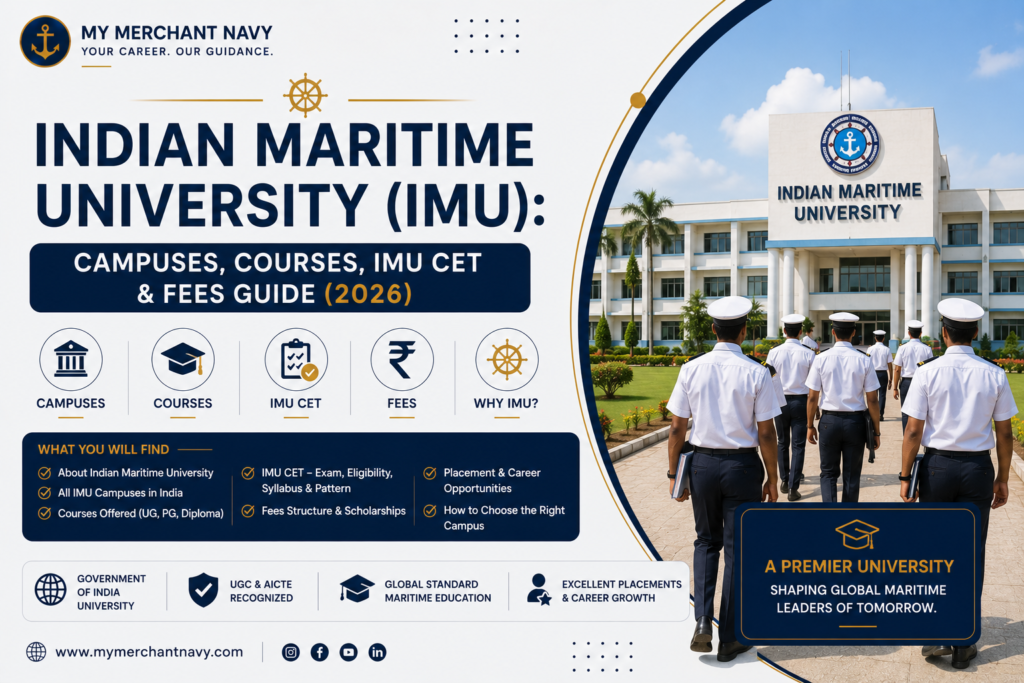
Indian Maritime University is a Central University established by an Act of Parliament in 2008, functioning under the Ministry of Ports, Shipping and Waterways, Government of India. Headquartered in Chennai, IMU is a teaching-cum-affiliating university — meaning it runs its own campuses directly while also affiliating a network of private institutes that follow its curriculum and admission process. IMU is a member of the International Association of Maritime Universities (IAMU), reflecting its role as India’s primary institution for global maritime standards compliance.
IMU operates six campuses across India’s major port cities:
Beyond these six, IMU has around 18–19 affiliated institutes across India — private colleges that offer IMU-recognised degrees and admit students through the same IMU CET process, extending its reach well beyond the six directly-run campuses.
IMU offers programs across diploma, undergraduate, postgraduate, and doctoral levels, spanning four broad streams — nautical science, marine engineering, maritime management/logistics, and general engineering:
Level | Course | Duration |
Diploma | Diploma in Nautical Science (DNS) | 1 year pre-sea + 18 months sea |
UG | BSc Nautical Science | 3 years |
UG | BTech Marine Engineering | 4 years |
UG | BTech (Naval Architecture & Ocean Engineering, at select campuses) | 4 years |
UG | BBA (Logistics, Retailing & E-Commerce / Shipping) | 3 years |
PG | 1-Year Post Graduate Diploma in Marine Engineering (for BE/BTech mechanical graduates) | 1 year |
PG | MBA (Shipping/Port/Logistics Management) | 2 years |
PG | MTech (Naval Architecture, Marine Engineering, and related specialisations) | 2 years |
Doctoral | PhD in Maritime Studies/Engineering | Varies |
Not every course is offered at every campus — course availability differs by location, so it’s worth checking the current IMU prospectus for which campuses run which programs before finalising your IMU CET city/state preferences.
Admission to IMU campuses and affiliated institutes runs almost entirely through the IMU Common Entrance Test (IMU CET) — a national-level exam conducted annually.
Exam structure:
Eligibility for UG courses:
Eligibility for PG courses:
Registration fee: ₹1,200 for General, General-EWS, and OBC (NCL) candidates; ₹800 for SC/ST candidates, for both UG and PG programs.
Admission process after the exam:
Important note for DNS aspirants specifically: IMU does not conduct a separate entrance test for later-year batches — candidates targeting a particular admission cycle must appear for the IMU CET held earlier in that same year, so timing your application correctly matters.
Fee structures vary by course and whether you’re at a directly-run IMU campus or an affiliated institute:
Course | Approx. Annual/Total Fees |
BTech / BSc Nautical Science / DNS (residential programs) | Around ₹2.75 lakh per year at IMU’s own campuses |
Diploma in Nautical Science, IMU Chennai | Approx. ₹2.85 lakh (total) |
BTech Marine Engineering, IMU Chennai | ₹3.5–18.6 lakh (total, varies by campus/affiliated institute) |
BTech Marine Engineering, IMU Visakhapatnam | ₹75,000–2 lakh per year |
Affiliated private institutes admitting through IMU CET (like Tolani Maritime Institute, HIMT College, and Samundra Institute of Maritime Studies) typically charge higher fees than IMU’s own campuses, even though admission runs through the same entrance exam — so it’s worth comparing a direct IMU campus seat against an affiliated-institute seat before finalising your counselling preferences.
IMU campuses attract placement visits from major shipping companies and maritime-adjacent employers each year, including names like Delta Corp and MMSI among the recruiters known to participate in campus placement drives. As with any maritime institute, actual placement outcomes vary by course, campus, and individual performance in interviews — treat placement claims (from IMU or any competing institute) as a starting point for your own verification rather than a guarantee.
IMU’s biggest advantages are government backing, comparatively lower fees than most private alternatives, six campuses to choose from, and a curriculum aligned with international STCW standards. The trade-off is that admission is competitive and entirely rank-based through IMU CET — there’s no direct-admission or management-quota route at IMU’s own campuses the way there sometimes is at private institutes. If you’re aiming for the most cost-effective, academically credible route into merchant navy and are prepared to compete on IMU CET rank, IMU is generally the strongest starting point; if you’re prioritising guaranteed company sponsorship above all else, it’s worth comparing against private institutes with direct shipping-company placement pipelines as well.
Yes. Admission to IMU campuses and its affiliated institutes is based entirely on IMU CET rank and the subsequent counselling process — there is no separate direct-admission route for Indian students.
No, for Indian students seeking undergraduate technical admission at IMU, IMU CET is mandatory. JEE Main is relevant only for Foreign Nationals/NRIs applying under the DASA scheme, which follows different criteria.
Six directly-run campuses — Navi Mumbai, Mumbai Port, Chennai, Kolkata, Visakhapatnam, and Kochi — plus around 18–19 affiliated institutes across India.
It varies by campus, roughly ₹75,000–2 lakh per year at IMU Visakhapatnam up to a wider ₹3.5–18.6 lakh total range at IMU Chennai and its affiliated institutes, so it’s worth checking the specific campus’s current fee structure directly.