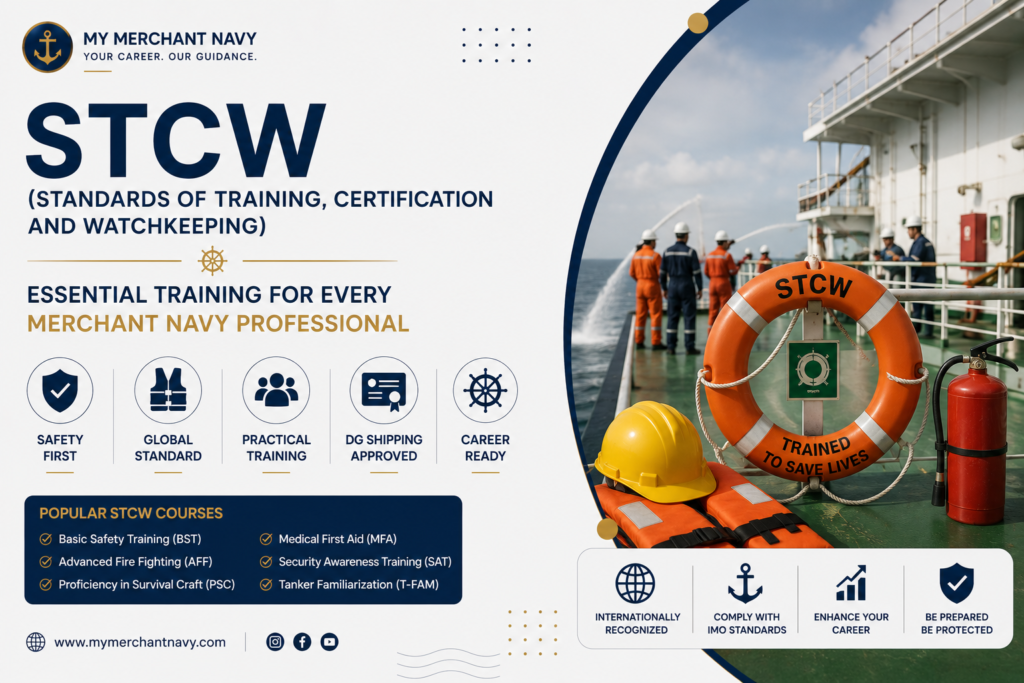
STCW stands for the International Convention on Standards of Training, Certification and Watchkeeping for Seafarers (1978, as amended). It’s a treaty administered by the International Maritime Organization (IMO) that sets the minimum training standard every seafarer worldwide must meet before going to sea — regardless of rank, department, or nationality. In India, STCW training is regulated by the Directorate General of Shipping (DGS) under the Ministry of Ports, Shipping and Waterways, and only DGS-approved institutes can issue certificates valid for an Indian CDC (Continuous Discharge Certificate) and CoC (Certificate of Competency).
Put simply: your BTech, BSc Nautical Science, DNS, or ETO qualification gets you eligible to train — but STCW certification is what makes you legally allowed to sail.
Every seafarer, regardless of career track, must complete these four courses before joining any ship — commonly bundled together as the Basic Safety Training (BST) package:
Module | Full Name | Typical Duration | Approx. Fee |
PSSR | Personal Safety and Social Responsibility | 1 day | ₹2,000–4,000 |
EFA | Elementary First Aid | 2 days | ₹3,000–5,000 |
FPFF | Fire Prevention and Fire Fighting | 3 days | ₹5,000–8,000 |
PST | Personal Survival Techniques | 3 days | ₹5,000–8,000 |
Together, these four modules typically take about 9–14 days to complete and cost roughly ₹15,000–₹25,000 for the full BST package at a DG Shipping-approved institute, though prices at premium private academies can run higher, up to around ₹50,000 depending on location and institute reputation.
Depending on your rank, vessel type, or the routes you sail, additional STCW certifications are required:
Which of these you need depends entirely on your rank and the type of vessel you’re aiming to join — a deck cadet heading to a tanker company, for example, will need OCTCO in addition to the basic BST package.
Unlike degree programs, STCW courses have minimal formal eligibility requirements:
There’s no entrance exam for basic STCW modules — admission is largely first-come, first-served based on batch availability at an approved institute.
STCW training is decentralised across dozens of DG Shipping-approved institutes rather than concentrated in a handful of “top colleges” the way degree programs are. The main hubs are:
Because fees and batch dates vary constantly between institutes, the safest approach is to shortlist 2–3 DG Shipping-approved institutes in your preferred city and compare current pricing directly — rather than relying on a fixed “best college” list, since STCW is a compliance certification, not a brand-driven degree.
This step matters more for STCW than almost any other maritime course, because certificates from unapproved centres are worthless for CDC/CoC purposes and money paid to such centres is unrecoverable. Before paying any fee:
Most STCW certificates are valid for 5 years from the date of issue. Before expiry, seafarers must complete a refresher course to revalidate — these are shorter than the original course (often 1–2 days per module) and confirm the seafarer remains up to date on safety procedures. Note also that the PSSR module was updated in 2024 (Course 957); seafarers who completed the older syllabus should check with their employer on whether revalidation to the amended course is required before their next sign-on.
Letting a certificate lapse while on shore leave is a common and entirely avoidable mistake — track expiry dates through your CDC and the INDoS portal, and book your refresher well ahead of your next contract.
STCW is a comparatively small upfront cost against what it unlocks. A full BST package costing ₹15,000–₹25,000 is the gateway to a starting seafarer salary in the ₹25,000–₹45,000 per month range (tax-free once qualifying sea-time thresholds are met) — meaning the investment is often recovered within the first month at sea. For officers, additional STCW modules (AFF, MFA, tanker endorsements) directly expand which vessel types and companies you’re eligible to join, which in turn affects earning potential significantly, since tanker and gas-carrier postings typically pay more than standard cargo assignments.
BST (Basic Safety Training) refers specifically to the bundle of four mandatory modules (PST, FPFF, EFA, PSSR) required for every seafarer. STCW is the broader international convention that BST — along with all the advanced and role-specific courses — falls under.
The four-module BST package typically costs ₹15,000–₹25,000 at a DG Shipping-approved institute, though fees vary by city and institute.
Most STCW certificates are valid for 5 years, after which a shorter refresher course is required to revalidate.
Yes. Your degree qualifies you academically, but STCW certification is the separate, legally mandatory safety training required before anyone — regardless of degree — can join a ship.