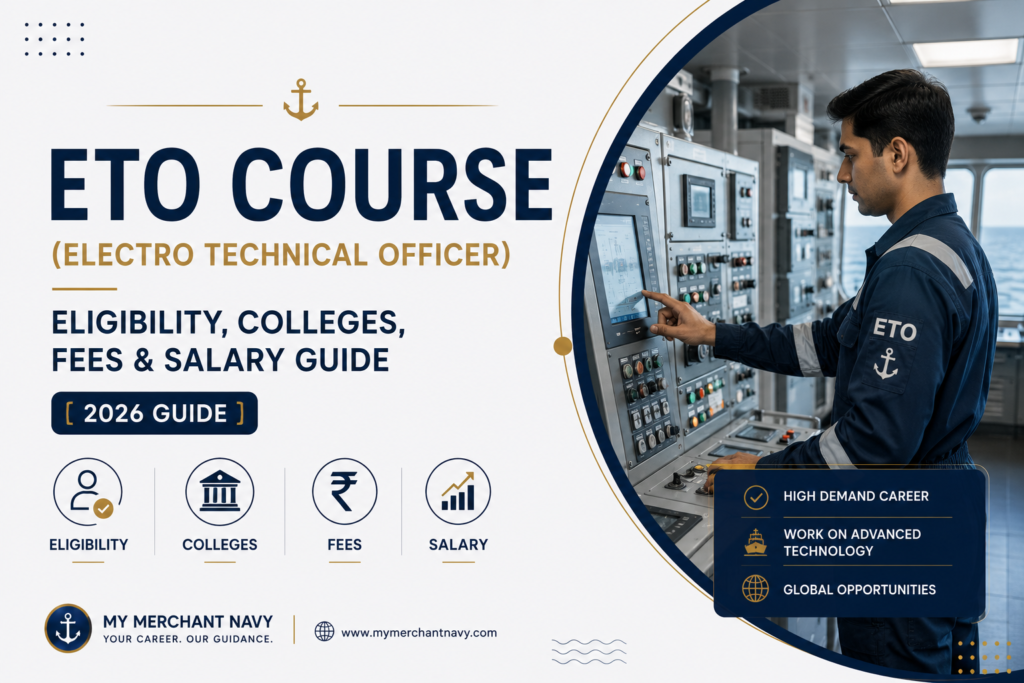
An Electro Technical Officer is a specialised ship’s officer responsible for all electrical, electronic, automation, and control systems on board — generators, switchboards, navigation electronics, alarm systems, and automation panels. <cite index=”19-1″>The role was created after the IMO’s 2010 Manila amendments to the STCW Convention introduced a formal category of certified officer for the growing use of electro-technology and control engineering on modern ships.</cite> Unlike marine (mechanical) engineers, <cite index=”28-1″>an ETO reports directly to the Chief Engineer and does not stand engine room watches — their focus is purely electrical and electronic systems.</cite>
It’s one of the most sought-after merchant navy courses precisely because it doesn’t require starting engineering from scratch — it’s a bridge course for engineers who already hold a relevant degree.
Eligibility is degree-based rather than exam-based, which is what makes this pathway attractive to electrical/electronics graduates:
Diploma holders in electrical/electronics streams are accepted at a few institutes, though a BTech/BE is the standard and more widely accepted qualification.
Fees for the 4-month ETO course are considerably lower than a full BTech marine engineering degree since it’s a shorter, focused program.
Institute | Location | Approx. Fees | Notes |
Anglo-Eastern Maritime Academy (AEMA), Karjat | Mumbai | <cite index=”18-1″>₹4.10 lakh</cite> | <cite index=”18-1″>100% placement — students are appointed to Anglo Eastern’s own fleet after the course</cite> |
Tolani Maritime Institute (TMI), Pune | Pune | <cite index=”19-1″>₹4.30 lakh (boys) / ₹3.44 lakh (girls)</cite>, inclusive of accommodation, food, uniform, and books | Campus placement interviews arranged with global shipping companies |
The Great Eastern Institute of Maritime Studies (GEIMS), Lonavala | Pune | <cite index=”20-1″>₹4,28,628 total tuition</cite> | 1-year certificate-level structure, 120 seats |
Academy of Maritime Education and Training (AMET), Chennai | Chennai | <cite index=”21-1″>₹2,86,000</cite> | 17-week course, one of the more affordable options |
Delhi Maritime Academy | Delhi/Kalkaji | Mid-range (varies) | <cite index=”22-1″>4-month course; hostel, one-time, and application charges are additional to tuition</cite> |
HIMT College, Chennai | Chennai | Mid-range | <cite index=”24-1″>DG Shipping-approved, STCW-compliant, does not require IMU affiliation</cite> |
Maritime Training Institute (MTI) – SCI, Mumbai | Mumbai | Company-sponsored (SCI) | <cite index=”23-1″>Recruits candidates directly through Shipping Corporation of India’s own scheme; no third-party agents authorized</cite> |
Fees vary by intake batch and whether a shipping company sponsorship is attached — always confirm current figures with the institute directly.
Many candidates secure a shipping company sponsorship before joining the course — companies like Anglo-Eastern, MSC, or the Shipping Corporation of India select candidates through a written test, technical interview, and psychometric assessment, then fund or subsidise their training in exchange for a service bond on their fleet. A sponsored seat usually means a guaranteed job right after training, while a self-funded seat leaves placement to the student’s own effort (though top institutes like Tolani and AEMA have strong placement networks either way).
ETO pay is quoted mostly in USD internationally, since seafarer payrolls are typically dollar-denominated, but rupee equivalents are useful for Indian comparison:
Stage | Salary |
Trainee ETO (onboard, pre-CoC) | <cite index=”33-1″>₹10,000–₹30,000 per month</cite> |
Certified ETO (with CoC) | <cite index=”34-1″>₹4.5–₹6.5 lakh per year equivalent</cite>, or <cite index=”31-1″>₹1–4 lakh per month</cite> depending on vessel type and company |
Experienced ETO (5–6+ years) | <cite index=”30-1″>$4,000/month on bulk carriers, $5,000 on oil tankers, $8,000 on LNG carriers, up to $10,000 on cruise ships</cite> |
Senior ETO / offshore roles | <cite index=”34-1″>₹8–10+ lakh per year, depending on vessel type and experience</cite> |
A few practical notes that affect real take-home pay:
Most ETOs spend the first several years sailing, then have options to:
If you’re deciding between the two merchant navy pathways: BTech Marine Engineering is a four-year degree open to any 12th-pass PCM student, leading to sailing ranks up to Chief Engineer with a defined promotion ladder. The ETO course is a four-month bridge program only for electrical/electronics engineering graduates, offering a much faster entry to sea and comparable or higher early-career pay, but with less of a formal onboard promotion structure. If you already hold an electrical/electronics degree, ETO is generally the faster and more cost-effective way into the merchant navy; if you’re starting from Class 12, BTech Marine Engineering (or BSc Nautical Science) is the standard route.
No. IMU affiliation and IMU CET are not required for ETO institutes — the mandatory approval is from DG Shipping, Government of India.
The pre-sea classroom portion is 17 weeks (4 months), followed by up to 8 months of onboard training as a trainee ETO
Trainee ETOs typically earn $400–$800 per month during onboard training, rising substantially once certified.
Most institutes require a BTech/BE in an electrical or electronics-related discipline, though a small number accept diploma holders — check individual institute eligibility before applying.