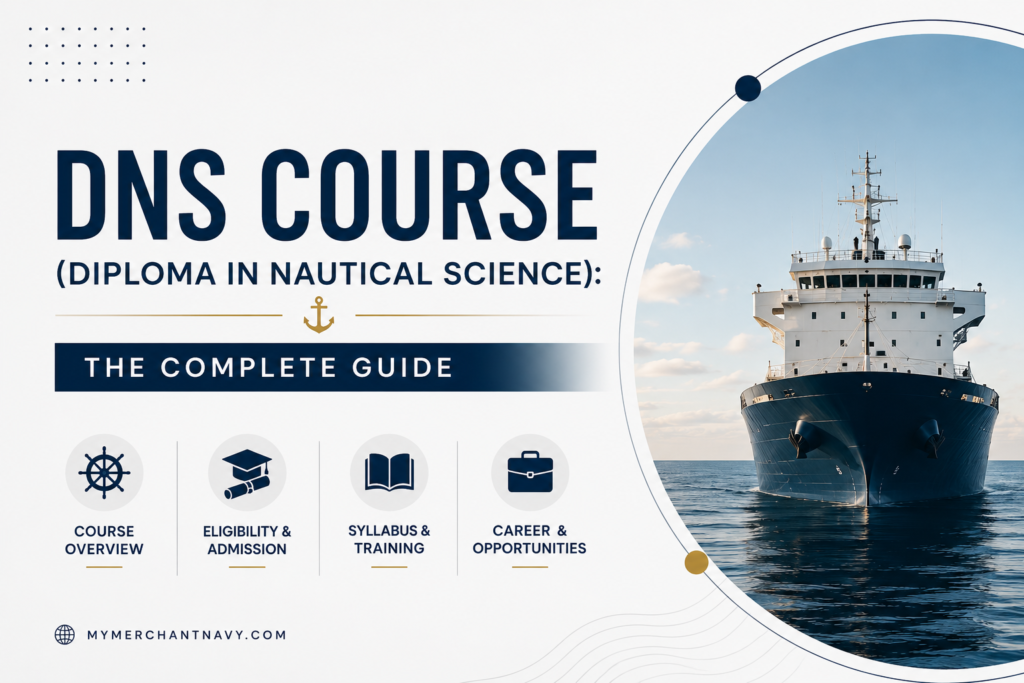
DNS Course (Diploma in Nautical Science): The Complete Guide

Table of Contents

The Diploma in Nautical Science, better known as DNS, is the most popular and fastest entry route into the Deck side of the Merchant Navy for students straight out of Class 12. This guide covers eligibility, admission routes, syllabus, fees, top institutes, and the career and salary path that follows — based on current listings from DG Shipping–approved maritime academies.

What is the DNS Course?

DNS is a one-year, DG Shipping–approved, residential pre-sea training programme conducted at Indian Maritime University (IMU)–affiliated institutes. It trains cadets in navigation, seamanship, and ship operations so they can join a ship as a Deck Cadet immediately after the shore-based training.

  • Duration: 1 year on-campus (two semesters of ~6 months each), followed by a mandatory 18-month structured shipboard training programme (SSTP) as a Deck Cadet.
  • Approving authority: Directorate General of Shipping (DGS), Ministry of Ports, Shipping and Waterways, Govt. of India; most institutes are IMU-affiliated.
  • Outcome: On completing the 18 months of sea time and clearing the Second Mate (Foreign-Going) Certificate of Competency exam, a cadet becomes a licensed Deck Officer — able to progress to Third Officer, Second Officer, Chief Officer, and eventually Captain (Master Mariner).

Eligibility Criteria

Requirements vary somewhat by institute, but the general benchmarks are:

  • Academic: Passed 10+2 with Physics, Chemistry, and Mathematics (PCM). Minimum PCM aggregate requirements differ by institute — commonly cited ranges are 60%. A minimum of 50% in English (10th or 12th) is also standard.
  • Alternate entry: Some institutes also accept a B.Sc. (Physics/Maths/Chemistry/Electronics with Physics) with 50–55% in the final year, or a B.E./B.Tech from an AICTE/UGC-recognised college with 50%+ in the final year, provided the 10+2 PCM criterion is also met.
  • Age: Generally between 17 and 25 years at the time of course commencement, though a few institutes cap it lower (around 20). Check the specific academy’s cutoff.
  • Medical: Must meet DG Shipping medical fitness standards, including eyesight (6/6 in each eye without visual aids, normal colour vision) and minimum height/weight norms.
  • Other: Most institutes require the 10th and 12th board exams to be no more than two years apart, and candidates who cleared 12th through an open/distance-learning board are typically not eligible.

Admission Process

There are two common routes into DNS:

  1. Sponsorship-based admission: A shipping company selects and sponsors a candidate (often covering part or all of the course fee), then places them at a DG Shipping–approved institute of the company’s choice. The typical funnel is: apply → written test/interview → medical exam → sponsorship letter → admission.
  2. IMU-CET-based admission: Candidates appear for the Indian Maritime University Common Entrance Test (IMU-CET), followed by counselling, medical fitness check, and document verification, to secure a seat directly at an IMU-affiliated institute.

Company sponsorship is generally preferred because it can reduce fees and comes with a guaranteed placement onboard after training.

DNS Syllabus (Broad Overview)

The one-year curriculum, spread across two semesters, typically covers:

  • Navigation and chart work
  • Seamanship and ship construction
  • Ship stability and cargo handling
  • Meteorology
  • Marine communication (GMDSS basics)
  • Maritime law and regulations
  • Firefighting, first aid, and survival-at-sea training
  • Marine pollution prevention and safety management

Fees

DNS course fees vary significantly by institute and whether the seat is sponsored:

Fee source/type

Typical range

General estimate (across academies)

₹2.5 – 3 lakh

Some institute-specific listings

₹4.5 – 7.5 lakh

The wide range reflects differences between mid-tier and premium academies, hostel/mess inclusions, and whether a shipping company is subsidising part of the fee through sponsorship. Always confirm the exact fee breakup (tuition, hostel, uniform, books, exam fees) directly with the shortlisted institute, since figures change year to year.

Top DNS Institutes (Indicative)

Some of the widely referenced DG Shipping–approved academies offering DNS include:

  • Anglo-Eastern Maritime Academy, Karjat
  • Tolani Maritime Institute, Pune
  • International Maritime Institute (IMI), Greater Noida
  • Academy of Maritime Education and Training (AMET), Chennai
  • HIMT College, Chennai

Selection is usually driven more by sponsorship and placement record than by brand name, since almost any DGS-approved DNS certificate is equally valid for the Second Mate CoC exam.

Career Path and Salary Progression

DNS graduates start as Deck Cadets and climb the rank ladder through sea time and further CoC examinations:

Rank

How you get there

Approx. monthly salary (India, indicative)

Deck Cadet (Trainee)

On completing DNS

₹25,000 – ₹85,000

Third Officer

After 18 months sea time + Second Mate (FG) CoC exam

₹1.5 – 3 lakh

Second Officer

Sea time + experience

₹2 – 3.5 lakh

Chief Officer

First Mate (FG) CoC exam + sea time

₹4 – 6 lakh+

Captain (Master Mariner)

Master (FG) CoC exam + command experience

₹8 – 20 lakh+

Note: salary figures vary widely across sources depending on shipping company, vessel type (tanker/LNG pays more than dry cargo), and whether pay is quoted in INR or converted from USD. Treat these as broad indicative bands rather than fixed numbers.

DNS vs B.Sc. Nautical Science — Quick Take

  • DNS: 1 year + 18 months sea time, lower cost, faster route to sea, no separate “pre-sea foundation” course needed before the Second Mate exam.
  • B.Sc. Nautical Science: 3-year degree + sea time, higher cost, but confers a full university degree alongside the same Deck Officer career path — useful if you want a formal Bachelor’s qualification alongside your CoC.

Both lead to the same Second Mate CoC exam and the same officer career ladder; the choice mostly comes down to time, budget, and whether a degree matters to you.

Frequently Asked Question

What medical standards are required for DNS?

Candidates must pass a medical examination conducted by a DG Shipping-approved medical examiner, including eyesight, colour vision, hearing, BMI, and overall fitness.

A Deck Cadet generally earns around ₹25,000 to ₹80,000 per month, depending on the shipping company and vessel type.

The DNS course consists of 1 year of pre-sea training, followed by onboard sea training as a Deck Cadet.

Yes, institutes require IMU-CET qualification for admission, while some company-sponsored programmes may have their own selection process but still clearing the IMUCET exam is essential for DNS. 

Prepare For Merchant Navy!
Fill your details below.