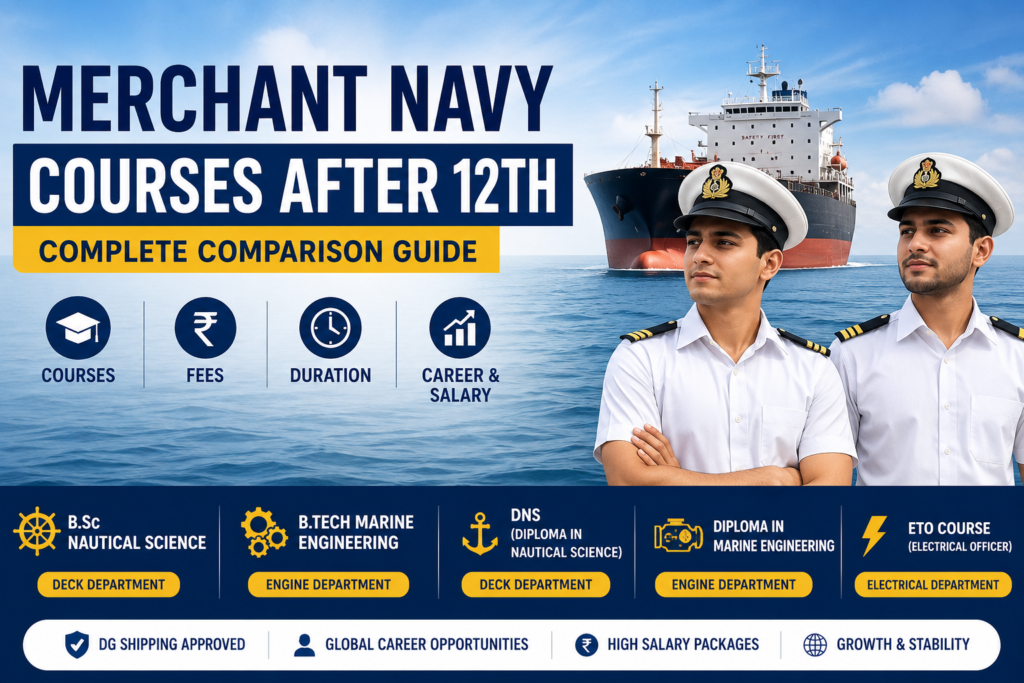
If you’ve finished class 12 with Physics, Chemistry, and Maths and you’re set on a Merchant Navy career, your next decision is the single most consequential one you’ll make in this process: which course to enroll in. Six distinct courses lead to an officer career at sea, and they differ meaningfully in duration, cost, day-to-day work, and long-term ceiling. This page is your comparison hub — a clear overview of every option, with direct links to a full dedicated page for each one.
If you haven’t confirmed you’re eligible yet, check our Merchant Navy Eligibility Criteria page first — medical fitness disqualifies more aspirants than any exam does. And if you’re still deciding between this after-12th path and the faster after-10th GP Rating route, read Merchant Navy Career After 12th for that comparison first.
Every after-12th course falls into one of two broad tracks, and this is the first fork in the road:
If you’re not sure which suits you, think about it this way: if you’re drawn to navigation, ship handling, and eventually commanding a vessel, the deck track and its path to Captain is your route. If you’d rather work hands-on with engineering systems and eventually run the engine room as Chief Engineer, the engine track is yours. Both lead to strong, well-paying careers — neither is the “backup” option to the other.
Course | Track | Duration | Entry Rank | Top Rank Achievable | Best Suited For |
Deck | ~1 year training + sea time | Deck Cadet → Third Officer | Master/Captain | Fastest route to an officer rank on the navigation side | |
Deck | 3 years | Deck Cadet → Third Officer | Master/Captain | Candidates who also want a formal degree alongside the same career outcome as DNS | |
Engine | ~1–1.5 years training + sea time | Junior Engineer → Fourth Engineer | Chief Engineer | Fastest route to an officer rank on the engineering side | |
Engine | 4 years | Junior Engineer → Fourth Engineer | Chief Engineer | Candidates who want a full engineering degree with maritime specialization | |
Engine | ~3 years | Junior Engineer → Fourth Engineer | Chief Engineer | A middle-ground diploma alternative to the full B.Tech route | |
Engine (specialized) | Shorter than GME/B.Tech | Electro-Technical Officer | Senior ETO / Electrical Superintendent (shore) | Candidates specifically drawn to electrical and automation systems rather than full mechanical engineering |
Fee figures for each course, compared side by side, are on our dedicated Merchant Navy Course Fees page — worth checking before you commit, since cost varies significantly both between courses and between institutes offering the same course.
DNS is the fastest way to become a deck officer. It’s a roughly one-year pre-sea diploma, after which you sail as a Deck Cadet, accumulate sea time, and sit for your Certificate of Competency exam to be promoted to Third Officer — a fully licensed rank. If your priority is reaching officer rank on the navigation side as quickly as possible, this is generally the most direct option. Full details, eligibility, fees, and top institutes are on our DNS Course page.
B.Sc Nautical Science covers essentially the same career outcome as DNS — Deck Cadet to Captain — but is structured as a full 3-year degree program rather than a shorter diploma. The trade-off is straightforward: it takes longer to reach your first sea posting, but you graduate with a formal Bachelor’s degree, which some candidates value for long-term flexibility, further study options, or simply parity with peers pursuing regular degree programs. See the full breakdown on our B.Sc Nautical Science page, and a direct side-by-side against B.Tech Marine Engineering on our comparison page.
GME is the engine-side equivalent of DNS — a focused, relatively fast route (roughly one to one-and-a-half years of pre-sea training) into the marine engineering officer track. You’ll sail as a Junior/Trainee Engineer, build sea time, and progress through Certificate of Competency exams toward Fourth Engineer and beyond, eventually to Chief Engineer. Full eligibility and fee details are on our GME Course page, with a direct comparison against DNS on our DNS vs GME page if you’re still weighing deck against engine as a track.
B.Tech Marine Engineering is the longest and most comprehensive route into the engine-room officer track — a full 4-year engineering degree, structurally similar to any other B.Tech program but maritime-specific and DG Shipping-approved. This approval is what qualifies you to sail as a marine engineer; a regular engineering degree, however similar the coursework looks, does not. It’s the right choice if you want the depth (and degree credential) of a full engineering education alongside your seafaring qualification. Details and top institutes are on our B.Tech Marine Engineering page.
DME sits between GME and B.Tech in both duration and depth — a diploma-level engine-room qualification, roughly 3 years, for candidates who want more structured, extensive training than GME but without committing to a full 4-year degree. See our DME Course page for eligibility and institute options.
ETO is a more specialized, generally shorter course focused specifically on the electrical, electronic, and automation systems that make up an increasingly large share of a modern ship’s operations. As vessels become more automated, demand for dedicated ETOs has grown, and it’s worth serious consideration if your interest leans toward electrical/automation work rather than full mechanical engineering. Full details on our ETO Course page.
If you’re still unsure which course fits, work through these questions in order:
Regardless of which course you choose, most institutes admit students through IMU CET (Indian Maritime University Common Entrance Test), which tests Physics, Chemistry, Maths, and English at the 12th-standard level. Some institutes also accept AIMNET scores or run their own entrance exams. Full syllabus, dates, and application steps — updated every admission cycle — are on our IMU CET page.
Course quality, faculty, infrastructure, and — critically — placement record vary significantly between institutes offering the same course, so the course you pick matters less on its own than the specific institute delivering it. Compare DG Shipping-approved institutes, their fee structures, and verifiable placement data on our Merchant Navy Colleges in India directory before finalizing your choice.
There’s no single “best” course — it depends on whether you want the deck or engine track, and whether speed (DNS/GME) or a formal degree (B.Sc Nautical Science/B.Tech Marine Engineering) matters more to you. Use the decision framework above to narrow it down.
Generally no, not mid-course — the training, certifications, and sea-service requirements are specific to each track. This is exactly why choosing carefully before enrolling matters more than it might seem at first.
Most do, though some institutes accept alternative entrance exams or run their own admission tests — always confirm the specific requirement for your target institute rather than assuming IMU CET is universal.
Not necessarily “better” — different. B.Tech gives you a longer, more comprehensive engineering education and a widely recognized degree; GME gets you to sea and earning faster with a more focused curriculum. Both lead to the same senior ranks over a career.